Frequently Asked Questions. |
Copyright BoatsToGo.com |
-
What to do if inflatable boat compartments become soft over time?
-
What are the differences between drop stitch air and plywood floors?
-
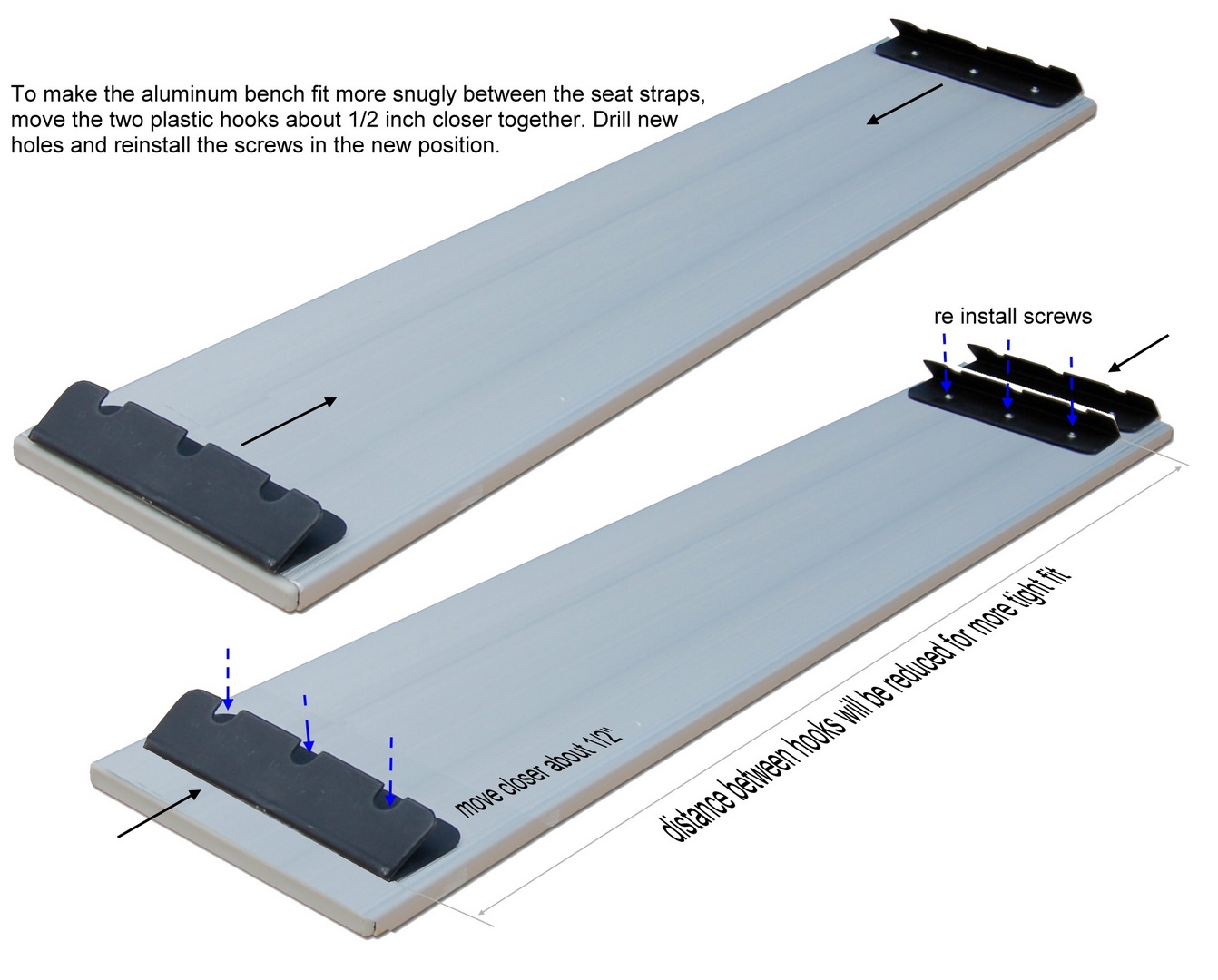
How to assemble Plywood or Aluminum Floor for inflatable boat?
-
What to do if inflatable boat gets accidentally punctured on the water?
-
Can I use inflatable boat, kayak or KaBoat for fishing or spear fishing?
-
What accessories come standard with Saturn inflatable boats?
-
Do I need to install a hydrofoil on the outboard motor for inflatable dingy?
-
How to protect air floors from accidental punctures or sharp dog claws?
-
How to properly tow inflatable dinghy behind a sailboat or yacht?
-
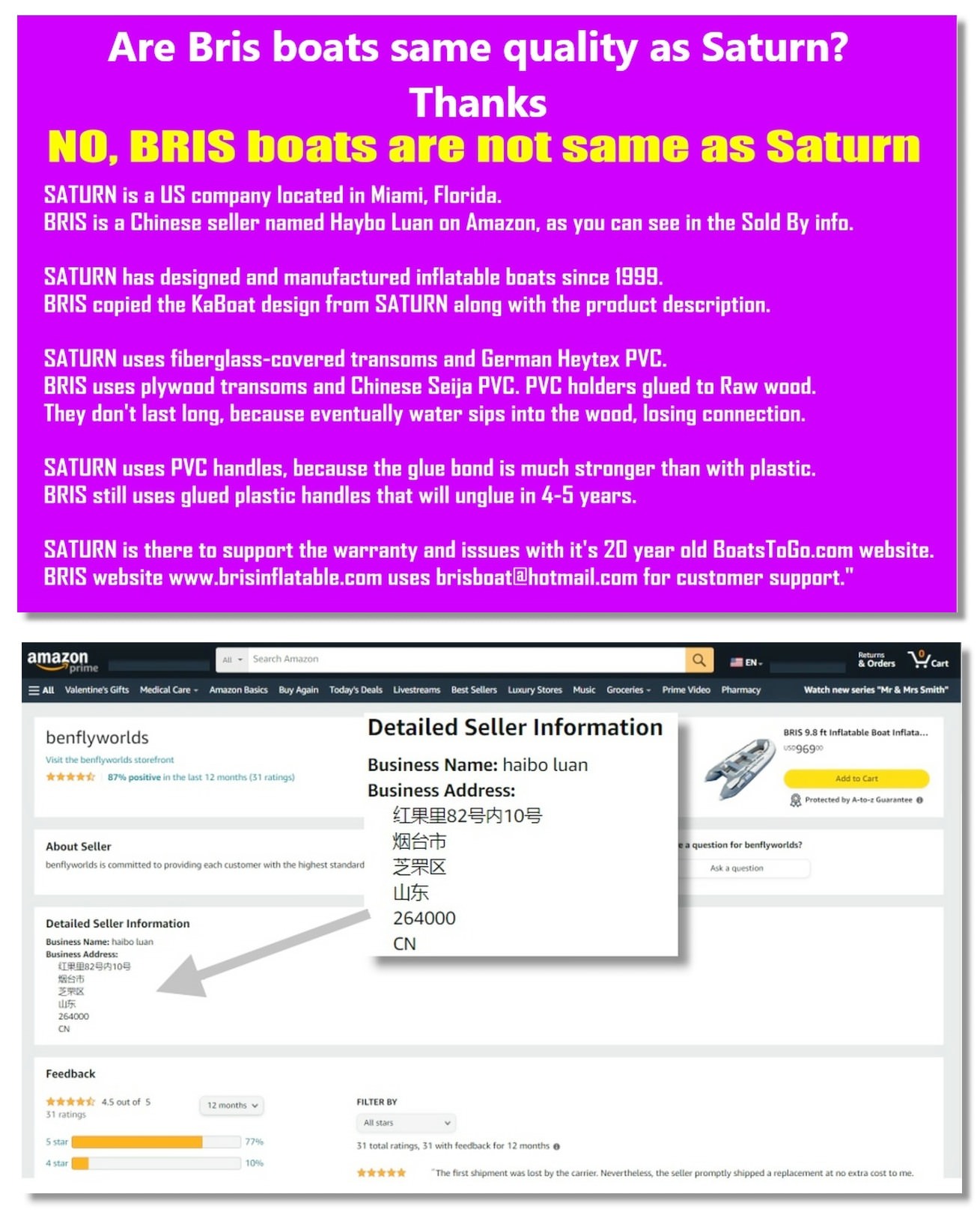
How Saturn inflatable boats are different from other brands?
-
What type of outboard motor can be installed on a Saturn inflatable boat?
-
How do I replace the air valve in my inflatable boat, kayak or raft?
-
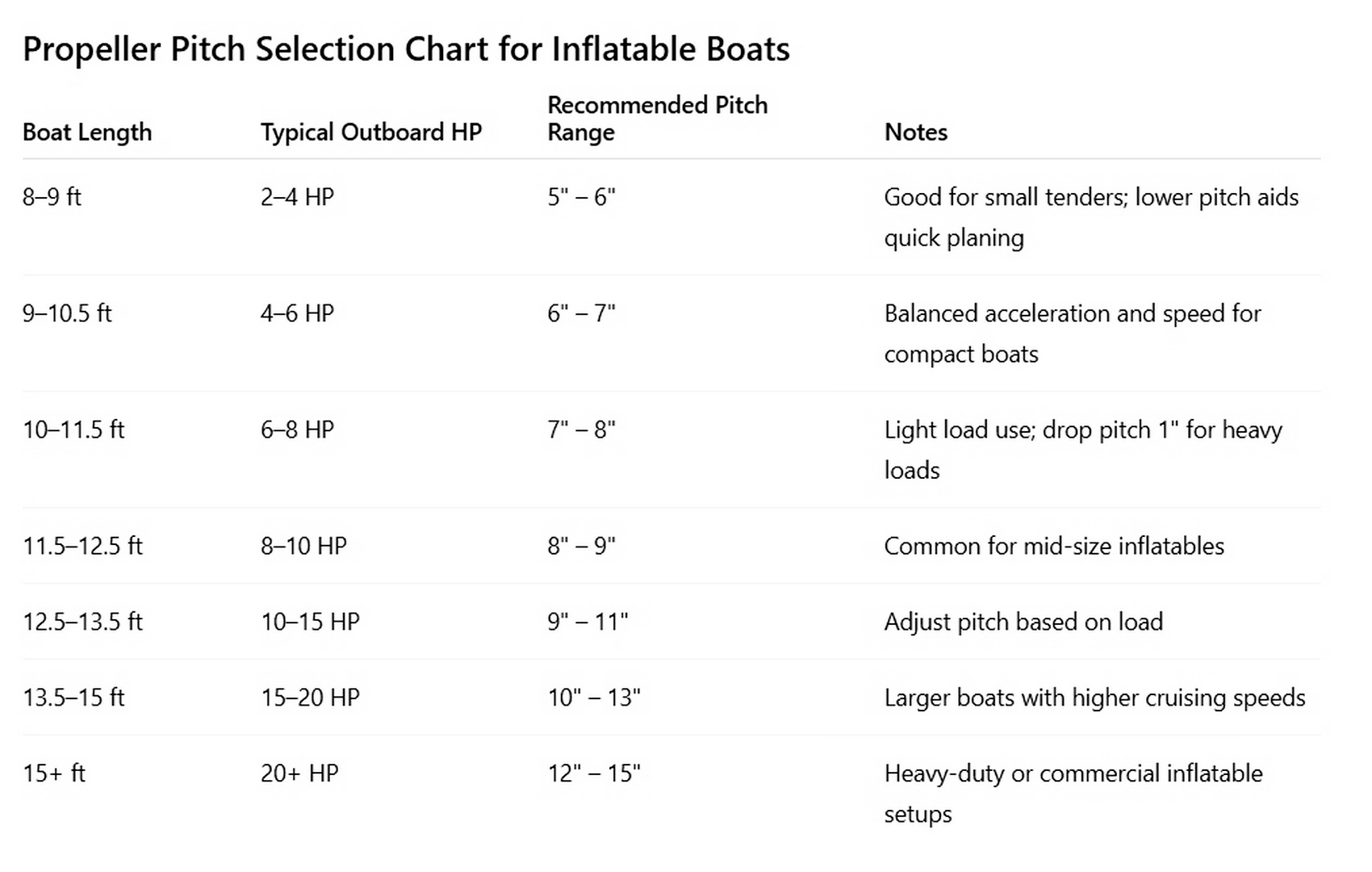
What outboard motor do I need to put inflatable boat on plane?
-
What are the steps to correctly assemble inflatable boat with hard floor?
-
What is the working air pressure, and do I need a pressure gauge?
-
How to make inflatable boat seat bench to be softer on a bumpy rides?
-
How to make swim ladder to get into inflatable boat from the water?
-
Where do I get a Bill of Sale and Manufacturer Certificate Of Origin in order to register my boat?
-
The keel tube under the floor is skewed to one side. How to fix it?
-
How can you avoid slipping in the boat seat while the boat is in motion?
How do I find and repair air leak in an
inflatable boat, kayak or raft?
If you are losing air pressure,
(aside from pressure loss commonly caused by colder
temperatures), check the boat over for air leaks. Air must to
escape somewhere for air chamber to become soft. No magic
here. The best tool to find air leaks is soap, shampoo or dish
detergent mixed with
water in a spray bottle. Start by
checking the valves first. Spray
around the valve on a suspected air chamber. If you see bubbles forming, check your valve
fitting and base and be sure the valve insert is screwed on
tight and pushpin is in correct position. See FAQ
below for more help with leaky air valves.
To find tiny leaks on a boat surface, fully inflate the boat until it's hard to the touch. Put some liquid detergent in a bucket of water and scrub it all over the boat with rag or big wash brush. Watch for elusive or tiny bubbles. When you find the first leak, keep looking. You might as well fix them all at the same time! Remember, the number one cause of slow leaks is due to poorly fitted valves. Unscrew the valve and clean the area. Make sure the little rubber O-rings are still good. They are the cheapest repair possible.
If you have no luck finding a slow leak with air bubbles, inflate the boat to it's maximum air pressure and try to listen for the leak. If you can narrow the area down, return with a spray bottle to identify the source of the leak.
Divide air chamber surface into imaginary squares, and apply soapy mix to that square and then look against surface to see for bubbles. If no bubbles are appears after 5-10 minutes, then move to another square. Don't forget to apply soapy water all along seams.
Punctures less than
1/8" in size can be repaired simply without a patch.
Deflate your boat, then clean and dry the area to be repaired.
Apply a small drop of glue to cover the puncture and let dry
for 12 hours. If you need to get on the water sooner, let dry
for 30
minutes and then inflate the boat, inflating the compartment
with the repair only 3/4 full. This repair might not be
permanent so add a drop again at a later date to make it
permanent.
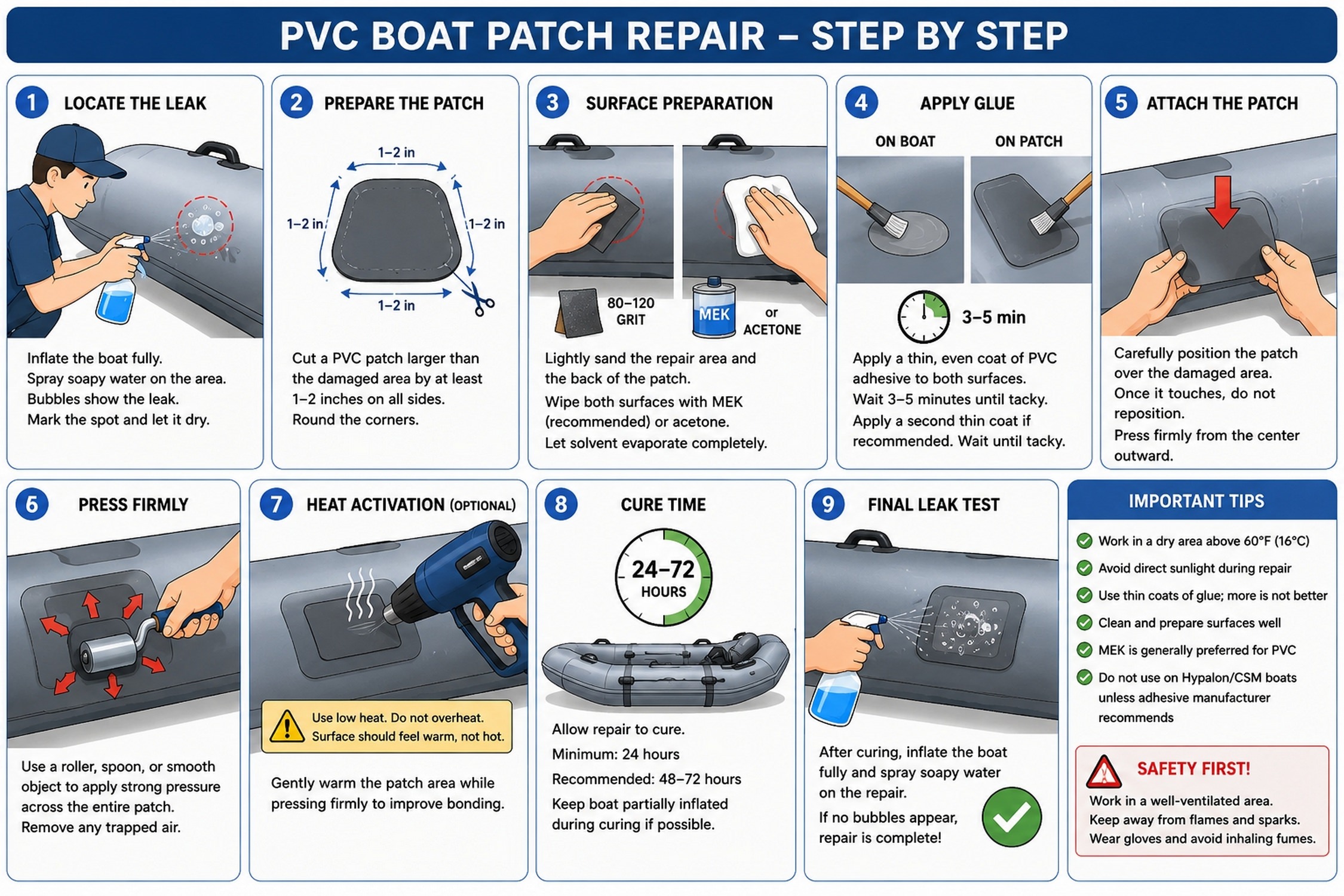
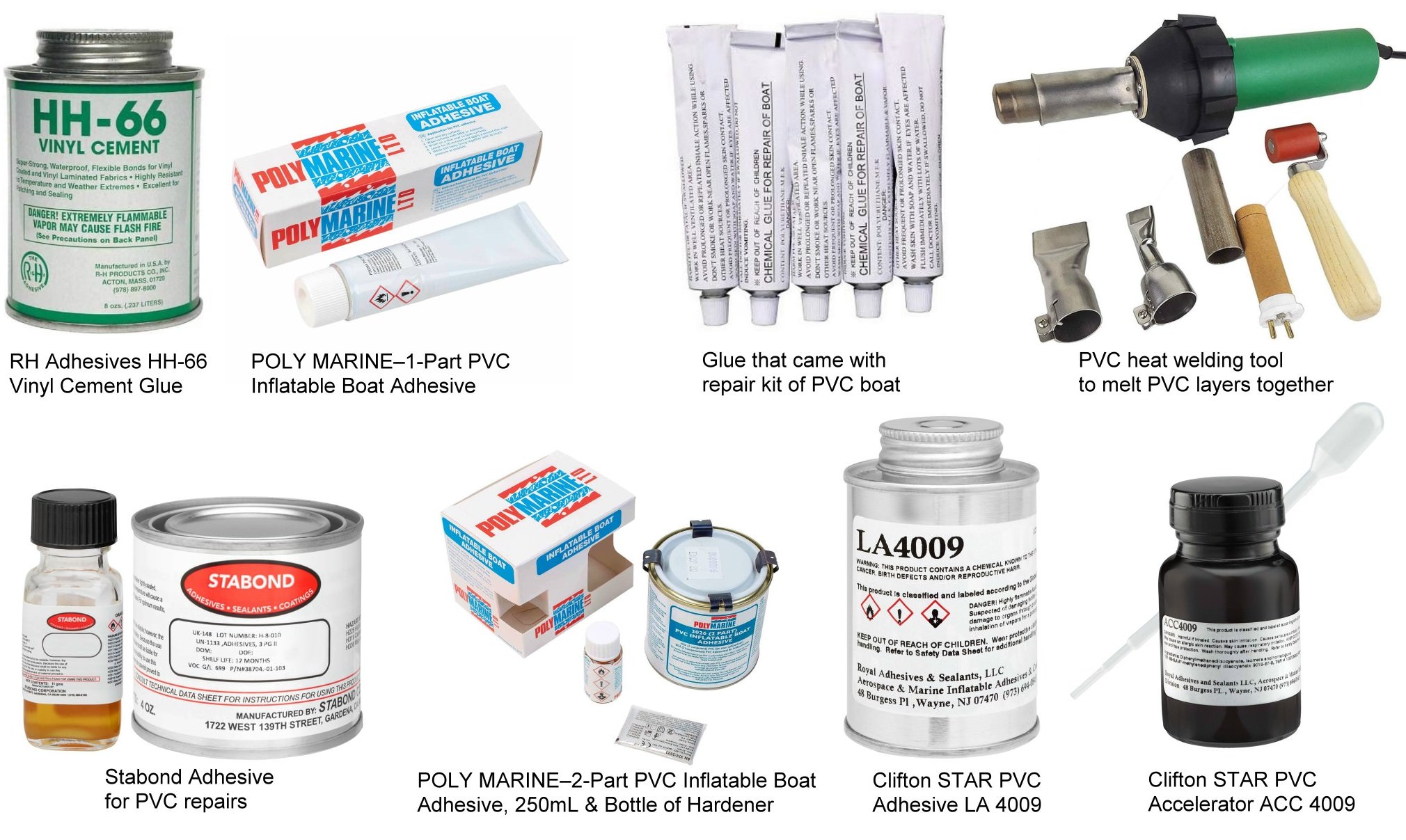
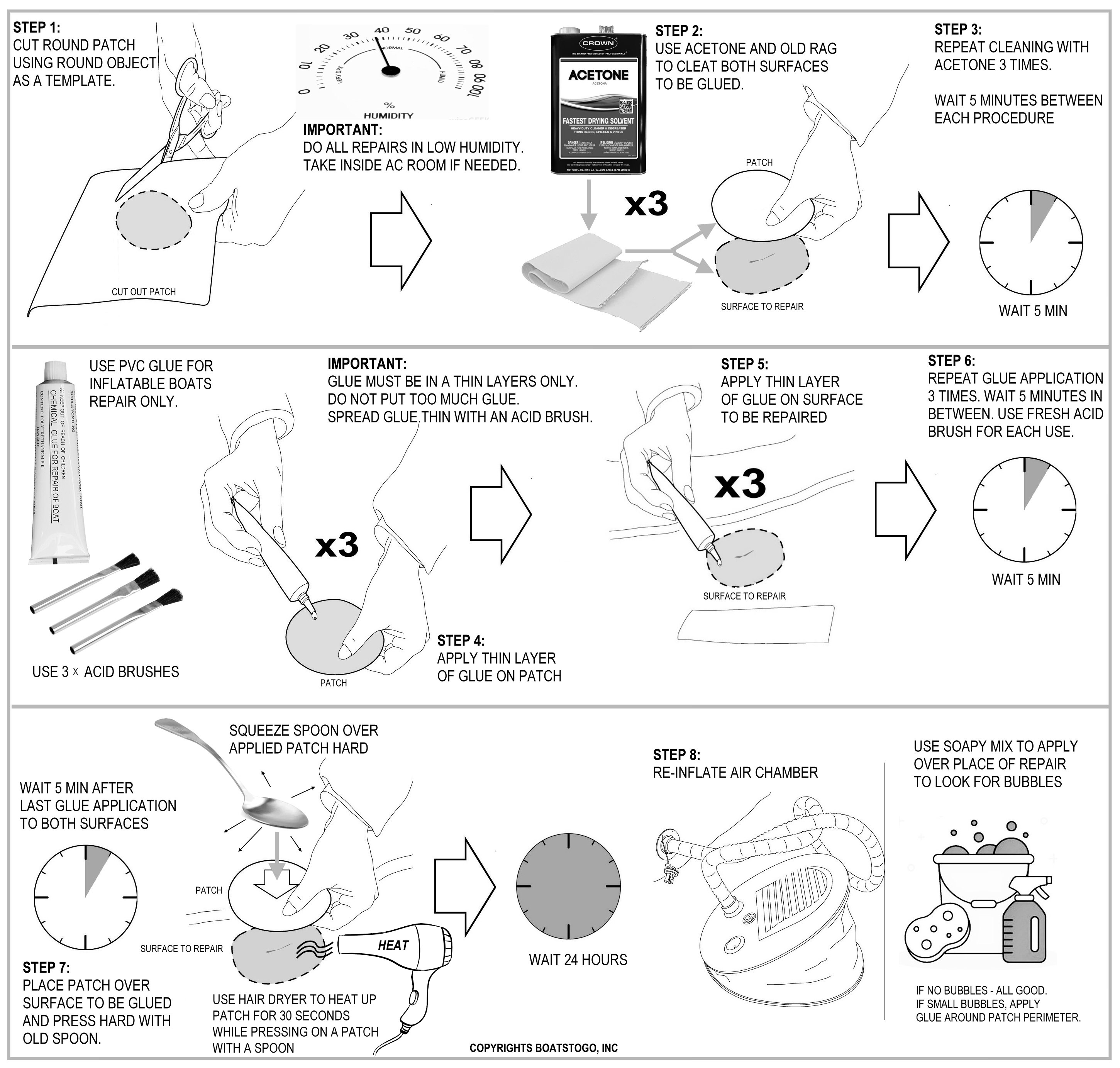
Your inflatable boat comes with a repair kit as standard equipment. It is recommended to do repairs in dry weather. Humidity will decrease glue bond. Cut a piece of repair material large enough to overlap the damaged area by approximately 1" and round off the edges. Apply glue to the under side of the patch and around the area to be repaired. Too much glue will often interfere with a proper repair. Allow adhesive to become tacky for 5 minutes, and then place patch on the damaged area. Use a weight to apply 3-5 lbs. of pressure for 24 hours. After the patch has dried, apply glue around the edges for a complete seal (dry 6 hours). Click here to read full instructions before starting ANY repairs.
Click Play to see Video how to repair holes in PVC boat or visit http://youtu.be/FrTuYP3UNmY?hd=1
What to do if inflatable boat compartments become soft over time?
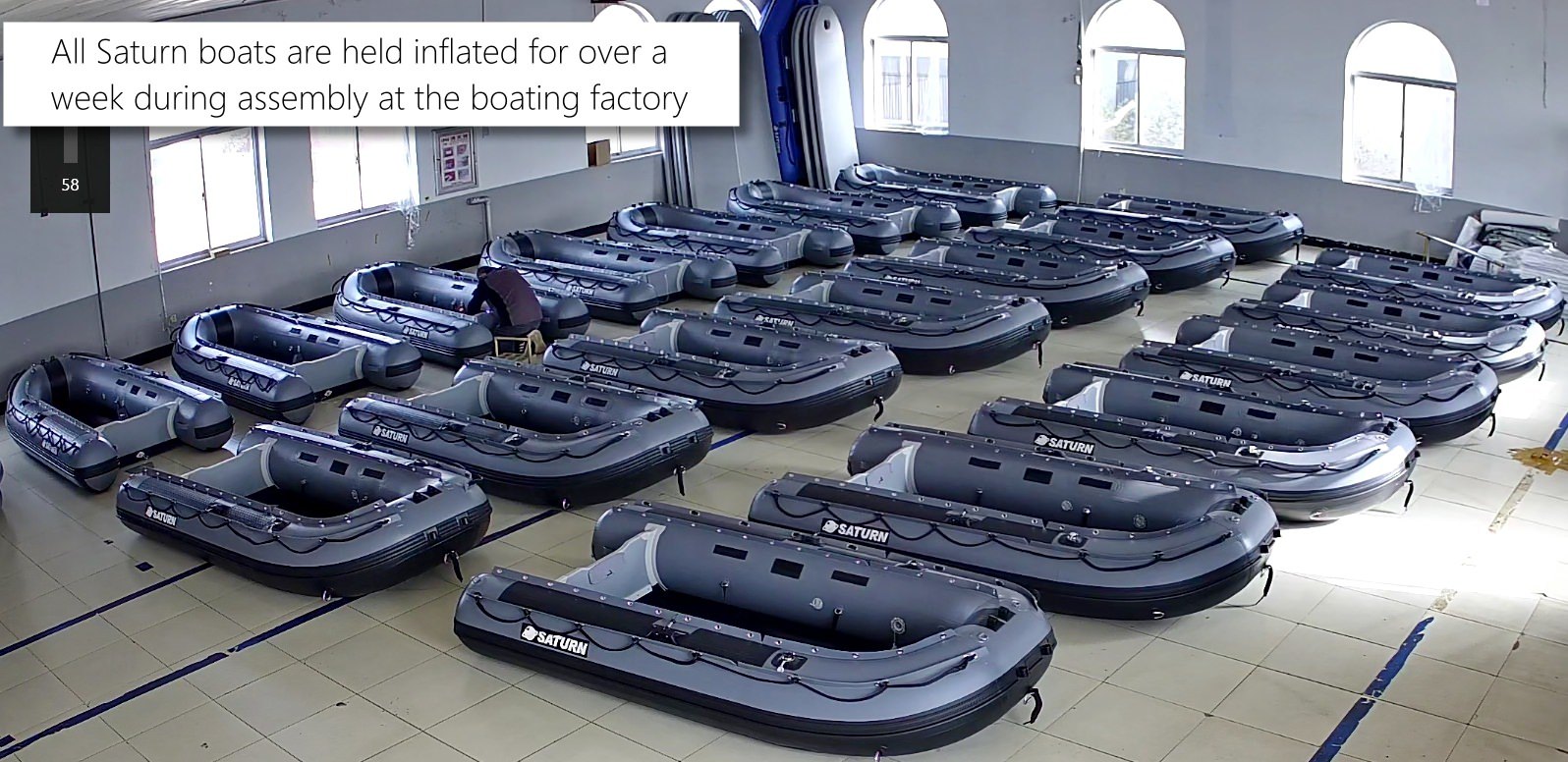
All inflatable products, including dinghies, kayaks and rafts are tested at our factory. They are kept fully inflated for 48 hours after the SATURN logos are applied to the product tubes. Therefore, it is extremely unlikely that brand new inflatable products are leaking air right out of the box. If air is escaping rapidly from a valve when you inflate your product for the first time, then most likely you are not properly locking the air valve.
If you leave your boat fully inflated, come back in a couple
days or weeks and the air chambers are soft, then there are
only 3 possible reasons for that: micro puncture somewhere on
a fabric surface, leaky air valve, and least likely is a leaky
seams, which is definitely a warranty issue.
Please note, that since air
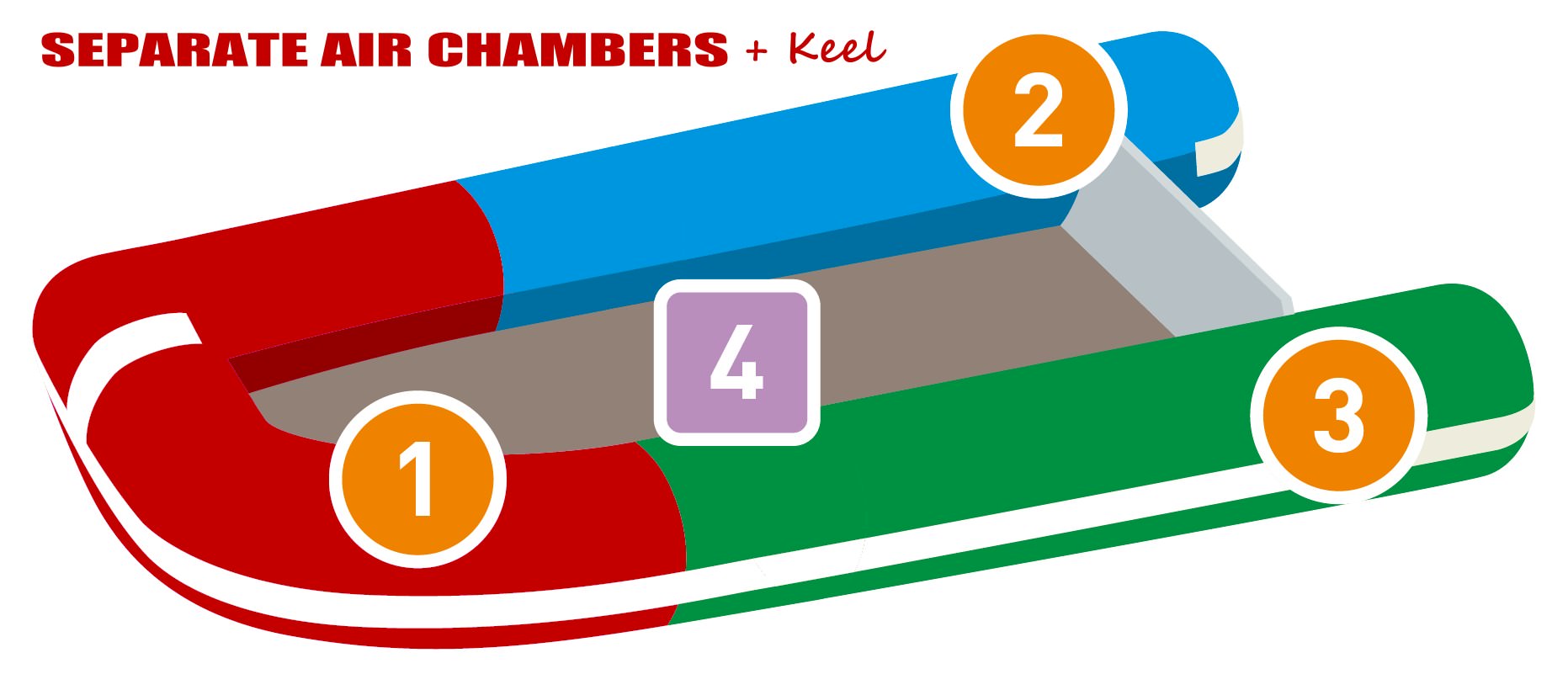
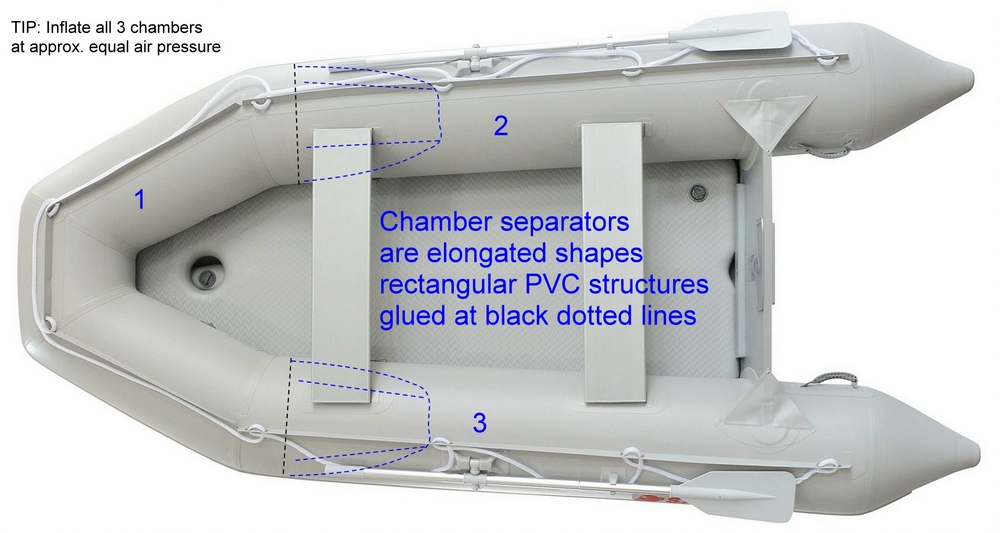
chambers are separated by inner baffles, it is possible that
air leak in one chamber will cause other chamber to become
soft too.
In
this case you will need to pinpoint which chamber is actually
leaking air. To do that you will need to deflate other
chambers, and inflate only one chamber at the time to the full
air pressure, and then see if it will get soft overt time, or
if you can find air bubbles anywhere with application of soapy
water. If inflated chamber holding air good and no soapy
bubbles are observed, then it mean that some other chamber can
be compromised. Repeat same operation with different chambers until
you will pinpoint leaking chamber.
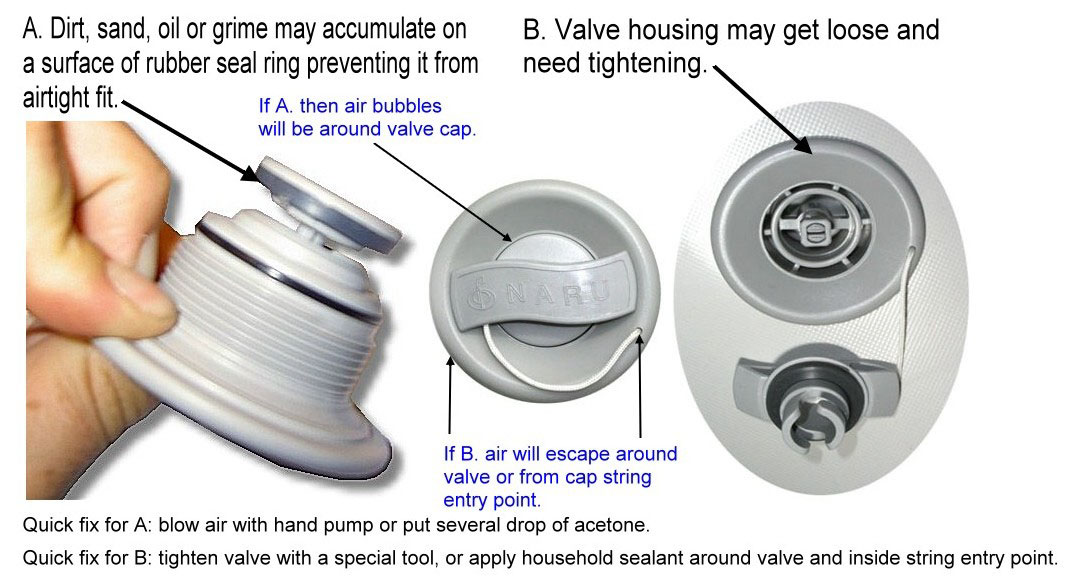
If you suspect that a valve is the source of the slow leak, you can verify this by fully inflating the air chamber, closing the valve cover and applying a soapy water mixture around the valve housing and cover cap. Air may escape around the valve
plastic body perimeter, cap body perimeter, or in the place where the string securing the valve cover cap enters the valve housing.
If air leak is very slow, it
might be difficult to immediately detect air bubbles. Try to
press on air chamber to increase pressure or leave for couple
minutes. If valve is leaking, then you will see small bubbles
forming in a place of air leak.
Over time, it is possible that debris, sand, dirt, oils and grime will accumulate on the rubber seal ring that is designed to keep the valve air tight. That may allow a small amount of air to slowly escape, making the tube and chambers soft. To remove debris you will need to blow air into the open valve with a hand pump while keeping the hose slightly away from valve's unlocked pushpin. It might be also possible to splash a bit of acetone inside the valve to clean off the dirt and grime. Leave the valve open to let the acetone evaporate. If that does not help, remove the valve with a special valve tool, clean the rubber seal with a cotton swab soaked in acetone and re-install the valve with a tight fit. If that does not help, then valve needs to be replaced.
If you are observing air bubbles around the valve housing perimeter while applying a soapy mixture, there is a possibility that the valve needs to be tightened with a specialized valve tool. Such tools may be purchased or borrowed at
http://www.BoatsToGo.com/valves.asp.
It should also be included with your repair kit.
You can also quickly seal the slowly leaking air valve by applying a thin layer of glue around the valve housing perimeter, or putting a drop of glue inside the opening, where the string that secures the valve cover enters the valve housing, if you observe air bubbles at that particular place. Household silicone sealant may also be applied in place of the glue.
Click Play to see Video how to replace air valve or visit http://youtu.be/IBQ3E8BoV5Q
What are the differences between drop stitch
air and plywood floors?
Once
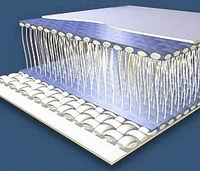
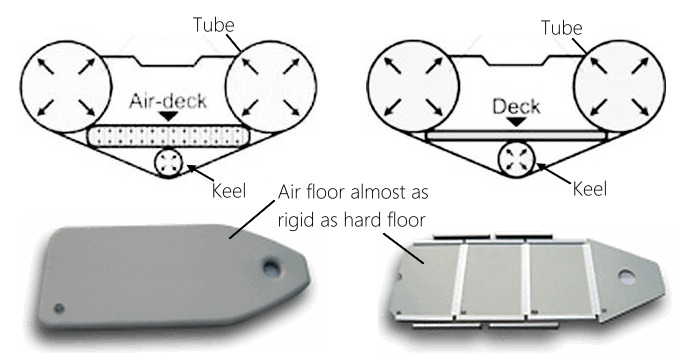
inflated, a high pressure air floor becomes as rigid as a plywood
floor. You can stand, walk or even jump on it, the same way you could
on plywood floor. Click here
for a video clip of the SD330 boat with an air floor.
If you are planning to inflate and deflate your boat often, then the air floor is your best solution, because the boat folds compactly. It's a breeze to assemble and inflatable boats with air floor. Just roll out-and inflate.
Assembling a plywood floor is a little bit of a hassle, and therefore we recommend plywood floors only if you keep the boat inflated most of the time. Another advantage of an air floor is that it is much lighter then a plywood floor. Due to it's lighter weight, the boat can achieve a higher speed much easier then with a plywood floor. Plus, an air floor is easy on your knees and absorbs vibrations better then a plywood floor. Because of these outstanding features, most of our customers prefer boats with air floors.
![]() |
All of our air floors come with a plywood support above the keel in the bow section of the boat. Because of these patented features, air floors become very rigid and flat. Flat floors perform much better then bended air floors of some competing brands. | ![]() |
| Air Floors | ![]() |
as rigid as |
![]() |
Plywood floors |
How to choose a right inflatable boat?
Please see all technical specifications for
Saturn inflatable boats at http://www.BoatsToGo.com/inflatable_boats.asp.
Max persons capacity displays how many persons the boat can transport safely. In general, to be comfortable on
an inflatable
boat, you will need to deduct 1-2 persons from the max boat
capacity. For example, SD260's will comfortably seat 1-2
people, SD290/330's 2-3 people, SD365/385 3-4 people;
SD430's will accommodate 4-5 people comfortable.
It is much easier to inflate and deflate boats with high-pressure air deck floors than boats with plywood floors or hard floors. It takes more time and skill to assemble plywood floor. In general, if you are planning to inflate/deflate the boat often, then select a boat with an air floor. If you keep the boat fully inflated for at least 1-3 weeks then choose a boat a with plywood or hard floor. If you keep boat on a trailer or in a dock, then a hard floor will not be a problem for you. If you keep the boat in the car's trunk and inflate it for only a day of fishing, then you will find it easier to deal with an air deck floor.
|
Selection recommendation charge based on intended activity: |
|||||
| inflatable kayak | inflatable boat 7-9' | inflatable boat 11-12' | inflatable boat 13-15' | inflatable river raft | |
| Yacht Tender | fair | excellent | good | good | |
| Exploring Harbors & Bays | good | good | good | excellent | |
| Coastal Areas Exploration | fair | fair | excellent | excellent | |
| Beach Cruising & Camping | excellent | fair | good | excellent | |
| Scuba In Shore | good | good | excellent | fair | |
| Scuba Off Shore | good | excellent | |||
| Fishing Ponds & Streams | good | excellent | fair | fair | fair |
| Fishing Lakes & Rivers | good | excellent | good | excellent | good |
| Saltwater Game Fishing | good | excellent | |||
| Duck Hunting | good | excellent | |||
| River Rafting | excellent | good | fair | fair | excellent |
| Lifesaving | good | good | good | ||
| Splashing around | excellent | fair | fair | fair | |
What is differences between Hypalon and PVC fabric?
There are two main types of fabric that
most inflatable boats are made of. They are either PVC or Hypalon. Most
Mercury, Sea Eagle and Zodiac inflatable boats are made of PVC.
Caribe, AB and Achilles inflatable boats were made of Hypalon
in past. However Hypalon was discontinued by its manufacturer
Dupont, and now it is sold under different name CSM.
PVC
Pro - Significantly less expensive then Hypalon.
Con - Won't last as long in the direct sunlight as Hypalon before it starts to
fade out (if left unprotected). Does not tolerate sunscreen
and insect repellent as well as Hypalon.
Hypalon or CSM
Pro - Will last significantly longer than PVC when exposed to prolonged periods of direct sunlight.
Will tolerate fuel spills, sunscreen, insect repellent, and exhaust fumes better than PVC.
Con - Significantly more expensive then PVC.
In general PVC fabric won't last as long as Hypalon fabric if the boat will be subjected to prolonged periods of direct sunlight and no measures have been taken to protect the PVC fabric from the sun (i.e. boat cover or UV protectant). After a number of years in direct sunlight the PVC fabric will become
sticky and fade out.
Exposure of PVC inflatable boat to direct sunlight is not a problem unless your boat is going to be outside and unprotected all
year long. If you only use the boat occasionally such as on weekends or while on vacation then it isn't a factor at all. Even if you leave your boat outside all the time the issue can be solved
simply by putting a boat cover or piece of tarp over your boat when it
is not in use.
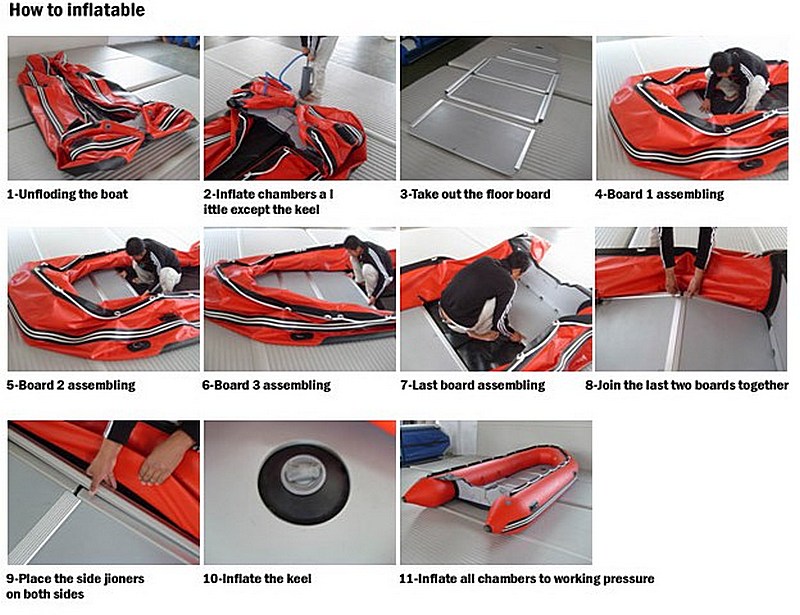
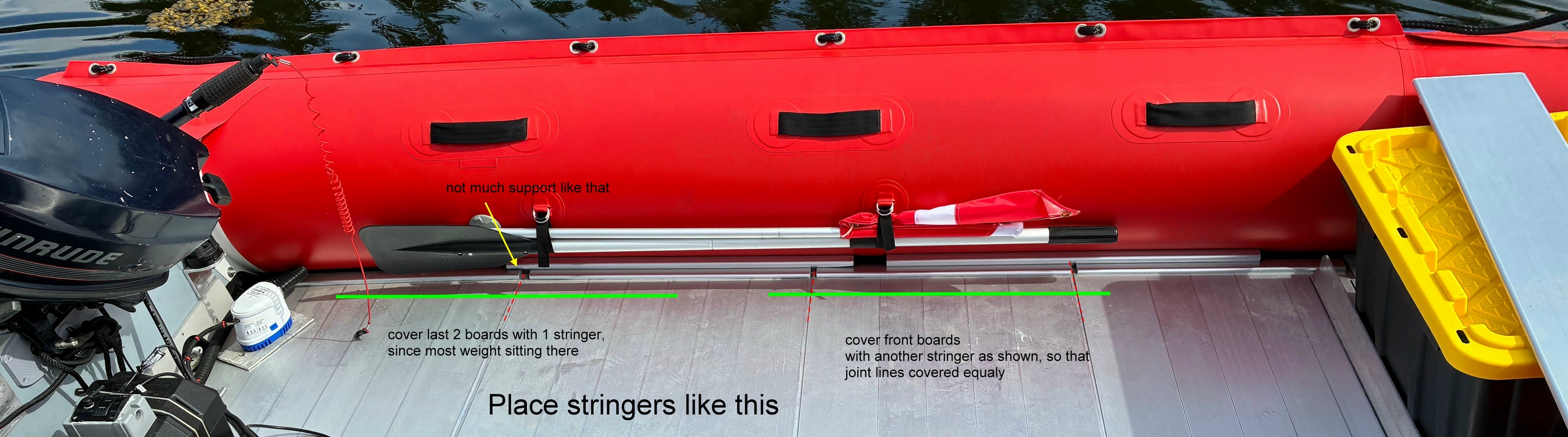
How to assemble Plywood or Aluminum Floor for
inflatable boat?
Please visit the Hard Floor
Assembly page if you have difficulties installing your plywood floor into your inflatable boat. You may also download
a Plywood Floor Assembly manual.
What to do if inflatable boat gets accidentally punctured on the water?
First of all - do not panic. Most inflatable boats, rafts
and kayaks have several
air chambers, and if one of chambers gets punctured, the boat will
stay afloat due to the buoyancy of the remaining air
chambers.
Inflatable
air chambers are separated by internal baffles that keep chambers separate in
case of accidental puncture, and designed to equalize air pressure between all
interconnected chambers.
We suggest that you always carry on board the following items - Personal Flotation Device (PFD) for each passenger along with a whistle, a marine emergency radio to call the Coast Guard for help if necessary, a hand pump, piece of duct tape (Gorilla Tape) and a small bottle of acetone.
If boat gets punctured below the water line, there is nothing much you can do except for pumping air with a hand pump in order to slow down the air leak. For quick emergency repairs in ripped inflatables, you can purchase a ClamSeal.
Punctures in accessible places, inside the boat, can be temporarily fixed with a piece of duct or Gorilla tape. To insure a good seal, the area around the puncture should be cleaned with acetone before applying duct tape. After that, you can pump in air to slow down the escaping air, and get ashore as soon as possible.
See very nice YouTube video showing inflatable boat ride with deflated air chambers. Note how riders pulling deflated air chamaber using safety ropes. This is not a Saturn boat, but idea is basically the same.
How long should I expect my
Saturn inflatable boat to last?
That is totally up to you. If you take good care of your
boat, it may last 5-10 years. If you do not take proper care
of the boat, it will
only last up to its warranty period. However, abused and mishandled
boats are not covered by the warranty.
When not in use, it is highly recommended to store PVC inflatable products in a well ventilated, shaded area. Humidity and heat are killers for PVC glue used in the assembly of inflatable boats. Do NOT store PVC inflatables in closed containers, boxes or storage areas with no ventilation and under direct sunlight. Humidity will accumulate in tightly closed storage areas and will weaken the chemical bond of PVC glue once significant heat is present.
To extend the lifetime of your boat by taking proper care of it, we are recommending following book: "INFLATABLE BOATS - Selection, Care, Repair, and Seamanship" by Jim Trefethen. ISBN number 0-07-065252-X. Available at www.amazon.com, or you may order it from the publisher: The McGraw-Hill Companies, 1-800-262-4729.
It is well known that the most common reason for premature boat aging is exposure to the sun and its damaging UV rays. Fabric discoloration, fading, breakdowns and damages to varnished plywood can be all attributed to direct sun exposure.
The
solution
is simple - when the boat is not in use, cover it or deflate
it. There
are plenty of Inflatables rotting under the damaging sun in
any local marine or harbor. If possible, deflate the boat,
clean it and store it in its carry bag.
If the boat is constantly
dragged behind your sailboat, left year round on a dock, or
left dirty and directly under harmful UV-rays, you can't
expect it to last forever. If you use a boat
cover, or at least cover boat with a piece of tarp, your SATURN will last much longer.
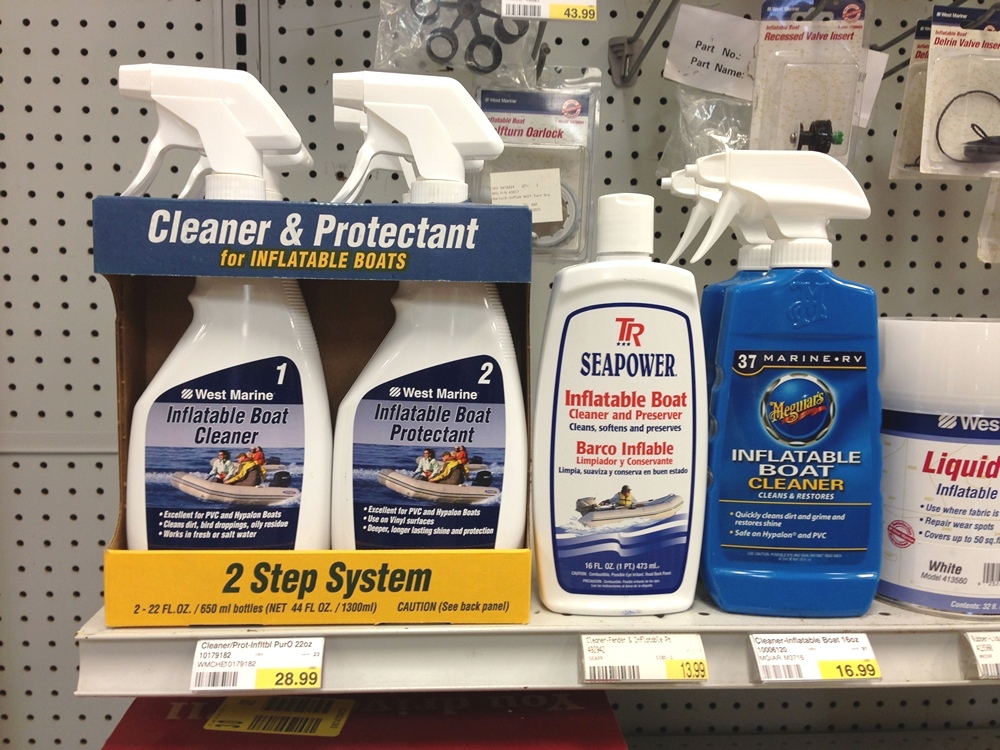
Try to keep the boat clean and free of chemical detergents and sun screen lotions that may discolor the fabric. We highly recommend boat cleaners available at the Inland Marine USA web site.
Please use ONLY cleaning solutions that are approved for
PVC fabrics. For example Inflatable
Boat Cleaner from NauticalEase or Cape Ann Inflatable Boat Protector
from Inland Marine. Do not use CLOROX, Windex or any other household
cleaners. These chemicals will make the fabric sticky over
time. Sun screen lotions may contain silicon that will also make
PVC fabric sticky. Clean the boat tubes of any sun screen
lotion marks to extend the boat fabric life cycle.
We
also recommend very convenient Swipes
Wipes, as they contain an excellent cleaning solution for
inflatable boats. These wipes remove any type of dirt, protect
against UV-rays and can make the boat look new again.
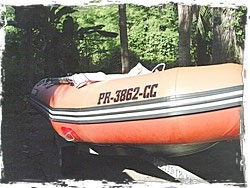
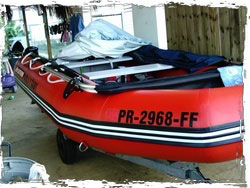
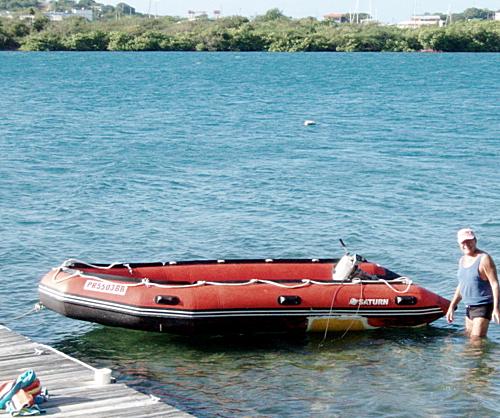
| Here is two identical 4-years old Saturn boats purchased at the same time and owned by two different customers in Puerto Rico. One boat was never covered, another was cleaned and covered with a boat cover. | |
![]() |
![]() |
|
Guess which one of above boats was covered and which one was left under the sun? |
|
What documents are needed to
register my inflatable boat?
You will need a Manufacturer's Statement of Origin (MSO) and Bill Of
Sale. The MSO and Bill of Sale are enclosed in a pouch attached to
the shipping box along with a Warranty Registration card. If any of
these documents are missing from the pouch, please visit the Downloads
page for replacements. Please fill out all necessary information: purchase
price, your name, address and date of purchase. Don't forget
to enter the correct HIN number. Don't bring blank forms to
the Tag agency. Fill them out first.
In very rare cases, some states may ask you to provide the MSO with a signed and notarized First Assignment. In general this absolutely unnecessary. The First Assignment is for you to fill out when you are going to re-sell the boat. BoatsToGo, Inc represents manufacturers in the US and a signed first page should be more then enough to register your boat. There are no manufacturers in the US who provide a notarized copy of the MSO. However some offices are just giving a hard time to customers. If it is absolutely necessary, we can provide a notarized copy of the MSO for a fee of $5. This is what the notary public charges us for the seal. Please visit http://www.BoatsToGo.com/payment.asp to send $5 payment if you need notarization.
What to do if a hand pump arrives damaged?
Saturn inflatable boats and rafts are of excellent quality
and workmanship. However, in efforts to pass the savings
on to
you, we are keeping costs as low as possible. Instead of
enclosing a high quality and expensive hand pump, and then
passing the cost to you, we are enclosing good quality generic
hand pumps. The hand pump enclosed with the boat is free and is a
complimentary gift to you.
In rare occasions, if FedEx drops the shipping box during handling, the hose of the pump may get squeezed by the weight of the boat and develop small cracks. The simplest and fastest solution for cracks in a hose would be to apply duct tape around the hose. This will make the hand pump fully operational again. However, if you wish to receive a new pump, please send damaged pump back for replacement. Click here for return address.
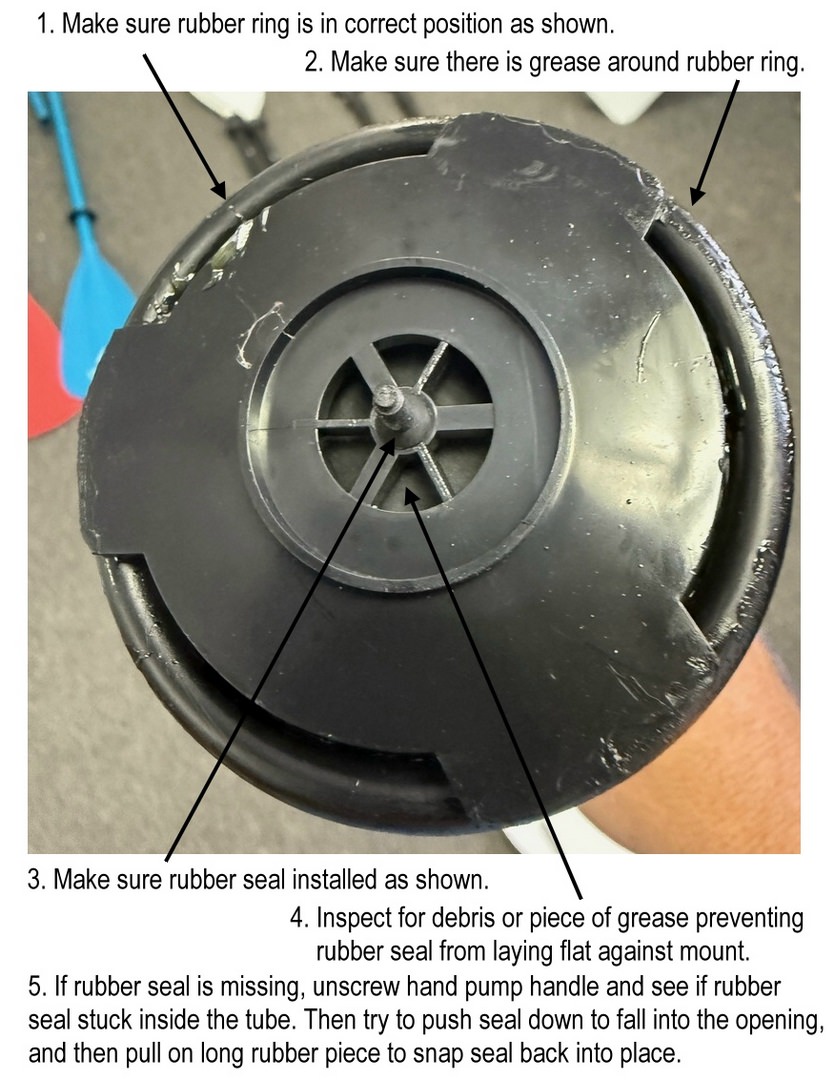
If the hose is fine and the pump doesn't provide enough pressure to inflate the boat, then unscrew the green cup with a T-handle and inspect the rubber seal on the plunger. If it's torn, let us know and we will send you a replacement seal.
Please note that high-performance foot and hand pumps are available from the following retailers that are not associated with BoatsToGo, Inc:
www.waterstrider.com/raft-air-pumps.htm
www.clavey.com/pumps.html
www.theboatpeople.com/atr_pumps.html
What to do if hand pump does not work?
The Saturn boats, rafts and kayak should be inflated until quite firm. If you find the hand pump provided is not able to achieve enough pressure, inspect the hose and all connections for leaks. Remove the hose and block the air outlet at the T handle with the palm or your hand while pushing down on the T handle. You should encounter very substantial resistance to pushing down when the air outlet is blocked. If instead the handle goes down easily, open up the pump by unscrewing the green
cylinder lid and inspect the black rubber seal to see if it is torn or improperly installed.
On the end of the plunger you will see 3 ridges: A top ridge, a 2nd ridge that is just below the top one, and a bottom ridge. When the black rubber seal is properly installed it is in the valley between the top ridge and the 2nd ridge, and it covers the 2nd ridge. Photo shows proper location and orientation of the black rubber seal.
The seal is bell-shaped so that its upper opening is smaller in diameter than its lower one. If it is upside down, remove it and turn it over. If it is in the wrong location (i.e., if it is below the 2nd ridge instead of above it), move it to the correct place as shown in the photo.
Once the rubber seal is properly situated, re-assemble the pump, taking care not to damage the seal. Use your fingers, and the fingers of a helper if necessary, to stuff the edges of the seal into the cylinder so that it does not get displaced or damaged as you insert it.
Can I use inflatable boat,
kayak or KaBoat for fishing or spear fishing?
Any of our Inflatables can be used for fishing, diving,
snorkeling, spear fishing or any other fun sport activity on
the water, as long as it's safe. However, please exercise
caution while handling fish around Inflatables. Pectoral
fins of most fish are extremely sharp and can easily puncture
any PVC or Hypalon fabric. If you just throw fish inside your
inflatable boat, there is a risk that the fish may jump and
accidentally puncture your boat. Pectoral fins of many fish
are so small and sharp that they may create micro punctures
that will not be noticed immediately. Most likely, punctures
by fish fins will cause slow leaks that may take several days
to notice. It is easy to fix micro holes by simply applying a
drop of glue. However, to avoid the possibility of such
accidental punctures by fish, we recommend dropping fish
inside a basket or cooler, or to keep a collapsible fish
basket attached outside of the boat with a rope. It is
advisable to avoid direct contact between the live fish and
the air filled chambers.
What accessories come standard with Saturn inflatable
boats?
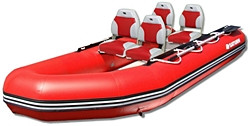
All boats except the SD430 come with 1 seat bench. All
boats come with a hand pump, repair kit, carry bag, aluminum
oars, 4' rope and either an air or plywood floor.
Optional accessories: boat cover, under seat storage bag with cushion, extra plywood seat, valve adaptor for electric pump, do-it-yourself plans for building sun-shade canopy, etc. We are constantly adding new accessories. Please visit our Accessories-Parts page for all optional accessories and spare parts.
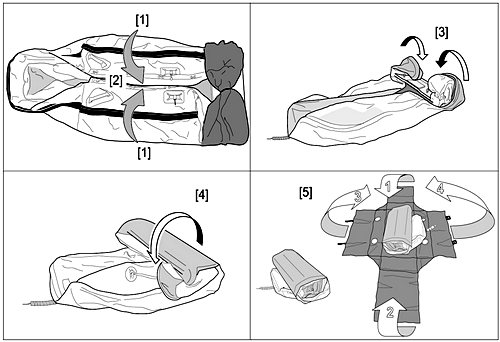
How to fold inflatable boat for compact storage?
Click here for step-by-step
instructions for deflating and folding your boat.
Do I need to install a hydrofoil on the outboard
motor for inflatable dingy?
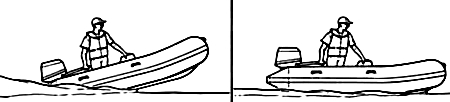
We recommend that you install a hydrofoil on the outboard motor in
order to improve speed and boat handling. A Hydrofoil will help
put the boat on plane much faster and will help maintain the
planning
effect at lower speeds. See picture below, on the left without a hydrofoil, on
the right with
a hydrofoil installed. You can find hydrofoil in West Marine,
on-line or Wal-Mart boating section starting at $25.

How to protect air floors from accidental punctures or sharp
dog claws?
An air floor PVC material has been designed to be strong and
puncture-resistant. But if enough pressure is applied with a
sharp object, like a knife or fishing hook for example, then a
puncture may sometime occur. Dog claws, in general, are not
sharp enough to puncture an air floor. But small pieces of sharp
broken glass or similar objects may stick to the insole of shoes while
boarding the dinghy and may also cut the surface of air floors in some
cases.
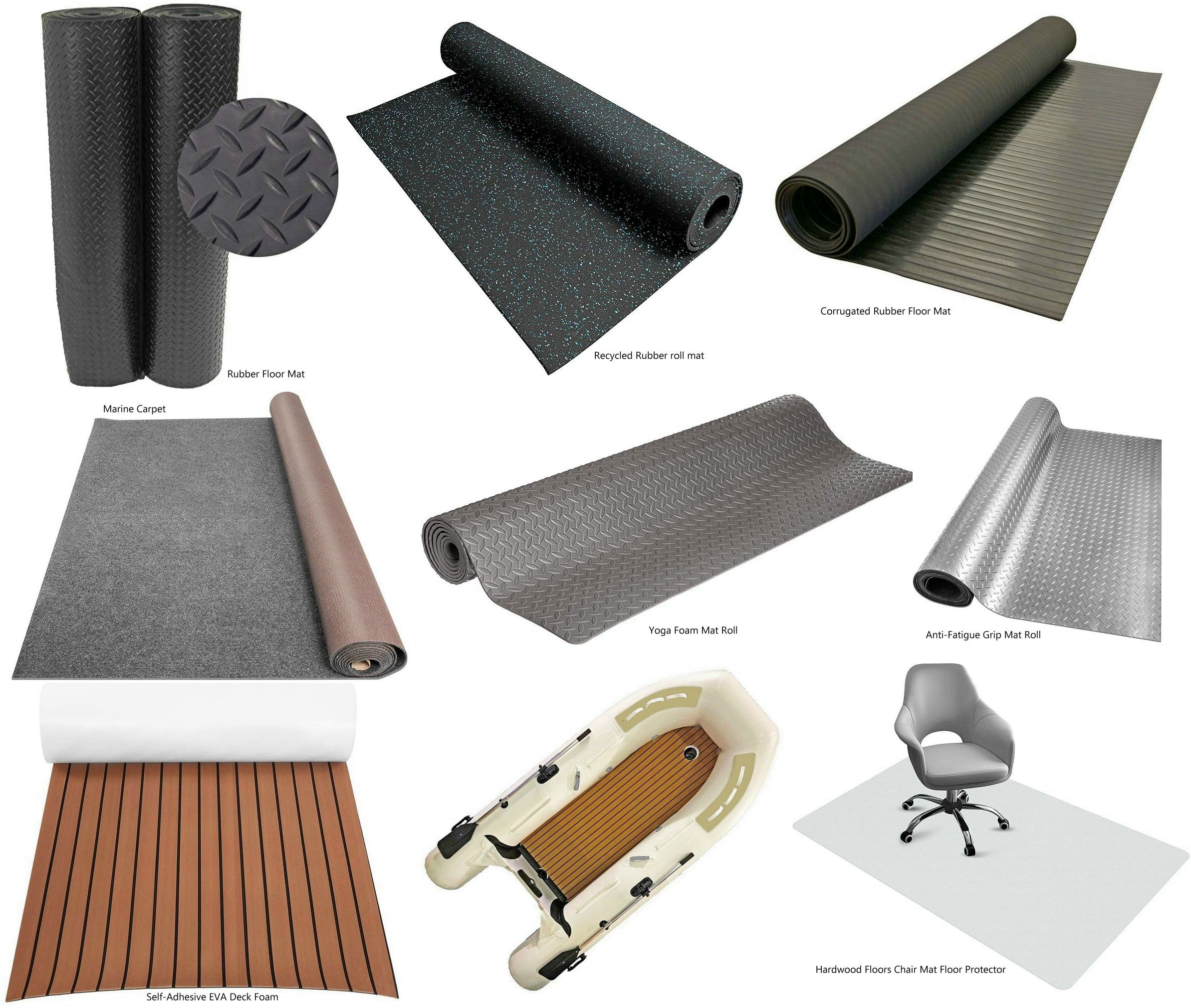
To avoid damage to the high-pressure air floor, and keep it as good as new, you can purchase a piece of vinyl floor covering in a hardware store, or just use regular carpeting. Cut the vinyl or carpet to fit the inside of the boat and over the floor. Use paper patterns first, to get a perfect fit. Then use this paper pattern to cut the new flooring.
Applying vinyl or carpet covering will make inflatable air floors virtually indestructible. Floor vinyl covering or carpet is flexible and may be rolled up for storage when boat is deflated.
How to properly tow inflatable dinghy behind a sailboat or yacht?
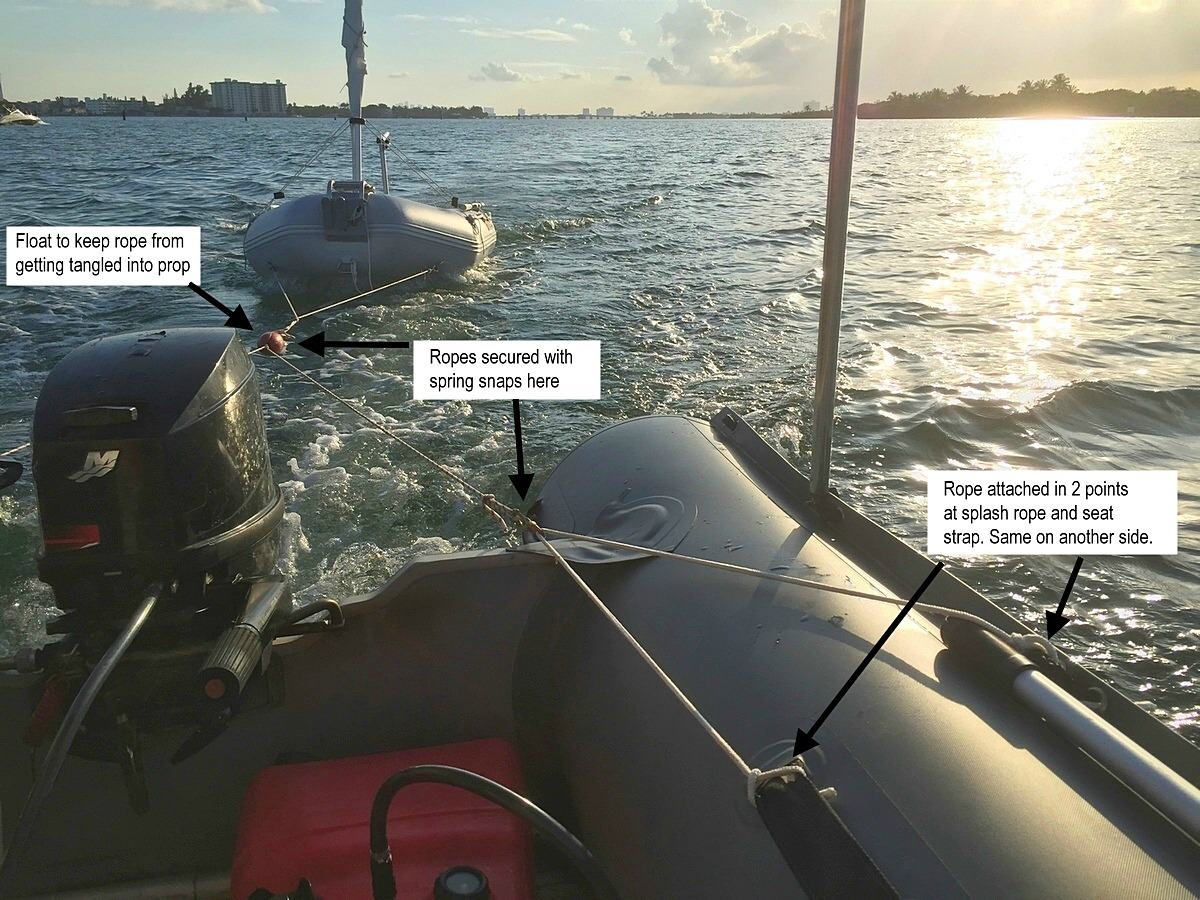
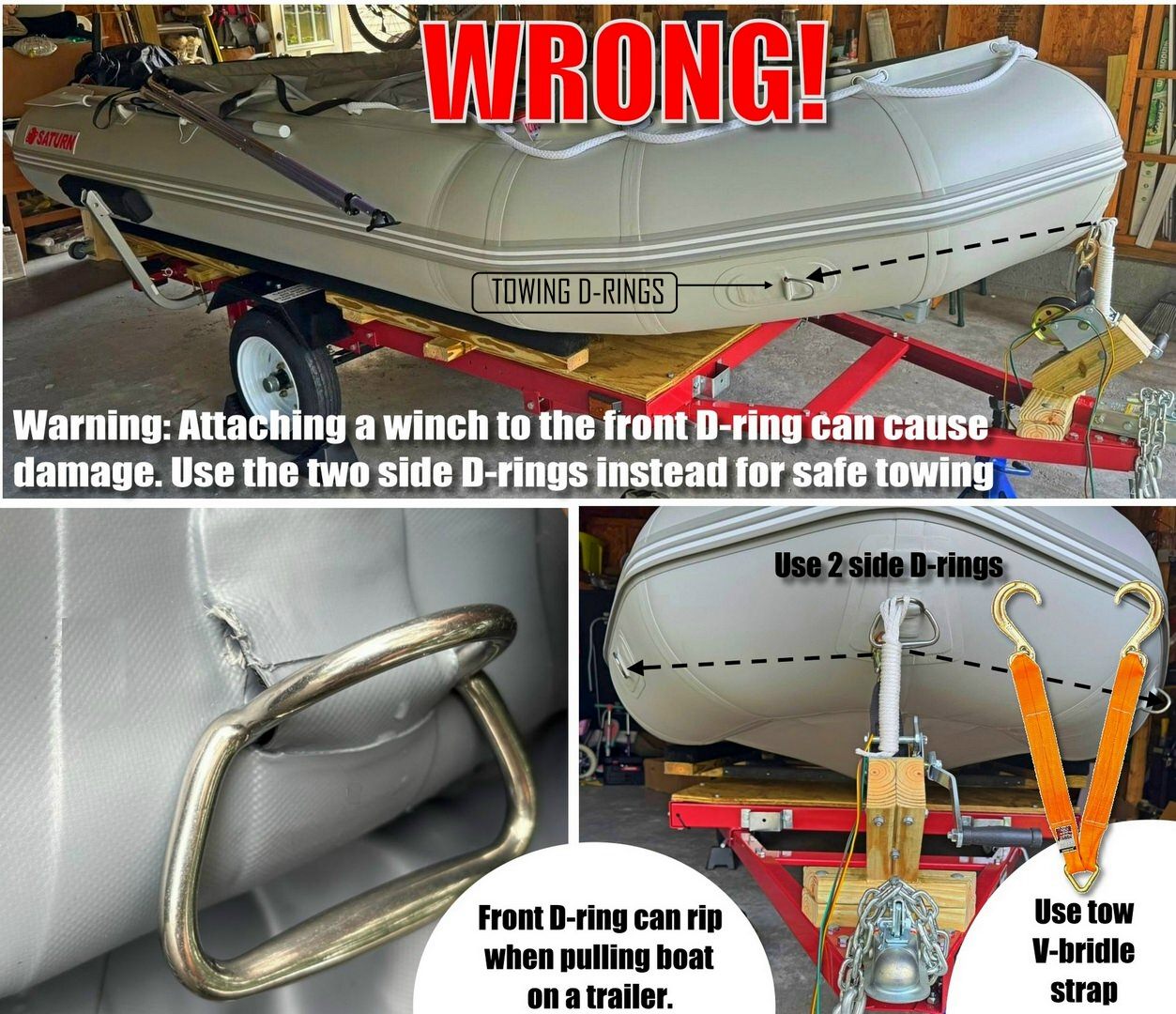
Towing bridle is necessary in order to properly tow your inflatable boat. Towing bridles are available at many marine retail stores and on-line. Do not tow
the inflatable boat by connecting rope to the central D-ring with integrated handle. Use towing D-rings on both sides of
the dinghy bow.
The most common mistake made when towing is the improper use of the towing bridle. Many boaters knot the tow bridle into a loop at the center, and attach a towing line there. This is wrong. The towing line should not be fixed to the bridle, but instead should end in a small bowline loop, through which the bridle passes. This allows the towline to slew back and forth in the bridle, and provides for tension
on both sides of the bridle. Not rigging the towline this way is the most common cause of failure of the pad eyes on the dingy to which the tow bridle is attached. It is inevitable that during towing, the dingy will rock a little from side to side, shifting the strain on the bridle from one side to the other. If the towline is rigidly fixed to the center of the bridle, one pad eye will be momentarily required to sustain the entire tow load. If the towline can shift its position in the bridle, both sides of the bridle will remain in tension, and the load will be distributed to both pad eyes on the dingy.
Many cruising sailors have small outboard motors for use with their inflatables, which creates a dilemma when it's time to tow: should the motor be left on the dingy while towing? The tendency to do this is proportional to the weight of the outboard and the difficulty in removing it and storing it on the boat. There are a number of reasons for recommending against towing with the outboard on the dingy.
First, there is the hazard to the outboard. In large seas the dingy might flip over, submerging the motor. It's also possible that violent motion in
the seaway could cause the motor to fall off the dingy transom. These things always seem to happen when you'd least
expect them to, usually when a ten-foot sea is running!
Another consideration is the additional tow load the extra weight of the motor will create. A completely empty inflatable is usually a very light craft and hence a very light tow load. When you add 70 pounds or more of motor and gas tank, you could very well be doubling the tow load from a small inflatable.
The problem most likely to occur in towing the dingy is shipping water aboard. It can quickly lead to failure of the bridle pad eyes, especially in those instances where the load is not being equalized. Even just six inches of water in an inflatable can weight
hundreds of pounds.
How can I prevent the outboard motor from damaging the transom while
transporting my boat on a trailer?
While transporting inflatable boats on a trailer with the outboard motor in a raised position, heavy outboard engines may
provide extra strain on a boat's transom. When a moving trailer hits a
bump or uneven pavement, heavy motors are capable of damaging
the transom. You can install a pole support from the end of
the trailer to the end of the outboard motor in order to
provide extra support for the motor's weight. These supports are
available at places that sell trailers for boats and/or
on-line.
Can I pump up my inflatable boat using electric pump only?
You will need to use a hand pump to provide proper air
pressure to the tubes if you are using low pressure electric
pump. Inexpensive electric pumps sold for $20-$50 in retail
stores will not provide enough
air pressure, and your boat will not operate to it's full
performance. You may quickly inflate all air compartments with
low pressure inexpensive electric pump, up to the point where no more air can be
electrically pumped inside, or about 80-90%. Then, you will need to use a hand pump until
the tubes,
keel and bow are hard to the touch.
To completely inflate boat or kayak or raft or any other inflatables to the recommended air pressure without use of hand pump, you will need a special High-Pressure Electric pump sold in our Accessories section.
How Saturn inflatable boats are different from other brands?
Saturn
Inflatable boats are made of the same quality materials as famous expensive
brand name inflatable boats. The workmanship is exactly the same or even better quality
then most overpriced brand names that you can buy in retail
marine stores. SATURN Our SATURN boats are made by a
major manufacturer
of inflatable boats in Korea.
Some of Saturn boats strong points:
- Very clean, hand-made seams. Glue does not stick out from seams.
- Double layer fabric at the bottom of all tubes .
- The Extra thick 1100 Dtex fabric with polyester support is a much thicker fabric than some other famous brands use.
- Flat and rigid air floor. Not bended in front like on most other brands.
- Safety valve that prevents over-inflation.
There are several reasons why our prices are the lowest in the US:
- We import directly from the manufacturer
bypassing the middleman.
- By conducting our business on-line we
avoid expenses that retail stores are passing on to their
customers.
- We do not invest as heavily in marketing
as other famous brands do.
- We don't have to maintain a large network
of dealers and retail stores.
- Our 2 year warranty doesn't force you
to pay for extra years that otherwise are just built-in
into the retail price.
What type of outboard motor can be installed on a Saturn
inflatable boat?
Short
shaft 15" outboard motors are recommended to be installed on
the 15" transom of Saturn
inflatable boats.
The lighter the outboard motor - the better. Either 2-stroke or
4-stroke engines may be installed on a boat transom, however 2-stroke engines are generally much lighter then 4-stroke
outboard motors.
Long shaft 20" motors are not recommended, but may also be installed if a short shaft o/b is unavailable. However a long shaft o/b may create extra underwater drag. Long shaft o/b may be raised a few inches with the help of a 2-3" wooden bar placed on top of the boat's transom.
Max O/B motor, as per technical specifications for Saturn inflatable boats, means that this particular HP power output motor will bring the boat on plane when the maximum persons capacity is reached. For example, the SD365 can take up to a 30 HP outboard motor, but a 9HP or 15 HP motor will move this boat very nicely with 2-3 people on board. However, to put the boat on plane with a full load of 5 people and gear, a 30 HP motor may be required.
Are Saturn inflatable boats certified or approved?
Manufacturer Identification Codes (MIC)
were assigned by the US
Coast Guard on May 6, 2003. Our boats have been CE, ISO and Germanischer Lloyd
Certified in Europe, Asia and Australia. The NMMA certification is
expensive and optional, therefore we did not applied for such a certification
in order to keep our expenses/prices as low as possible.
How to properly operate inflatable boat air valve.

The valve has a special pushpin
inside. This pushpin has two positions, both up and down. When it is pressed in the down position, air will
escape. If you turn the pushpin in any direction it will
pop up. This will lock air inside and prevent it from
escaping through the valve. Before inserting the air pump tube
into the valve, please make sure that the pushpin is in
the upper,
popped up position. Once the pin is in the "popped
up" position, insert the air pump tube into the valve
and inflate the boat until it becomes hard. Once you remove
the air pump, air will seal the valve and
will no longer escape. If you would like to deflate the boat
later on, press down on the pushpin and turn it in any direction
until it stays in the pressed down position. Air will
immediately escape from the tubes thru the valve.
How do I replace the air valve in my
inflatable boat, kayak or raft?
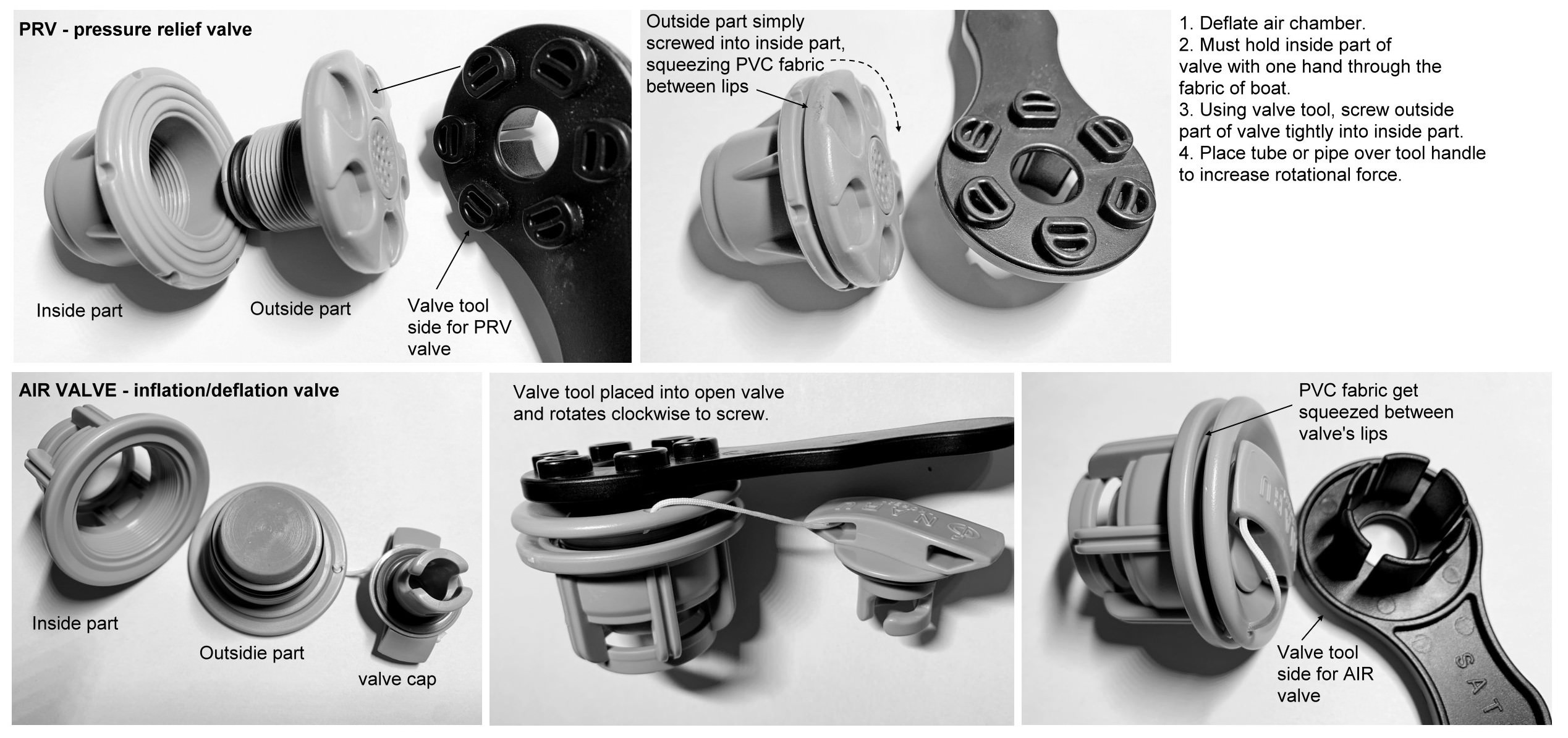
Please go to the valve assembly page
to see how a damaged or defective valve can be replaced.
Replacement valves and tools for their replacement can be
ordered at http://www.BoatsToGo.com/valves.asp.
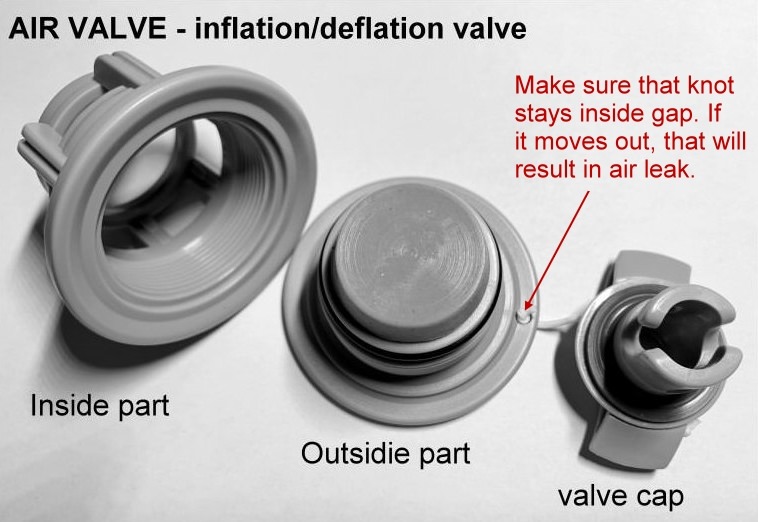
Top part of the valve can be simply unscrewed for cleaning or replacement. New
valve can be screwed in place of old one. In most cases, simply cleaning rubber
seal inside the valve will fix slow leak that may develop over time due to the
grime and residue collection on top of that seal.
What outboard motor do I
need to put inflatable boat on plane?
Under normal circumstances,
with half of a maximum persons/load capacity, or about 50% of
the maximum
O/B power rating may be necessary to put the boat on plane. For
example: the SD365 is rated for up to a 30 HP outboard motor. But
a 15 HP
with hydrofoil installed would be enough to put a 12' boat on
plane with 1-4 people and a light load.
The lighter the motor, the faster boat will run. 2-stroke engines, while still possible to find, are much lighter then 4-strokes, and will provide same power at less strain to the transom.
Max O/B Motor means: the maximum power outboard motor that can be safely used to plane a boat loaded to the maximum capacity on normal water surface conditions. Please exercise common sense and caution when using maximum motor capacities. Do not jump from wave to wave as new 4-stroke motors are much heavier then 2-strokes and provide extra strain on the transom.
What are the steps to correctly assemble inflatable
boat with hard floor?
These are the steps you should
follow to correctly inflate the boat:
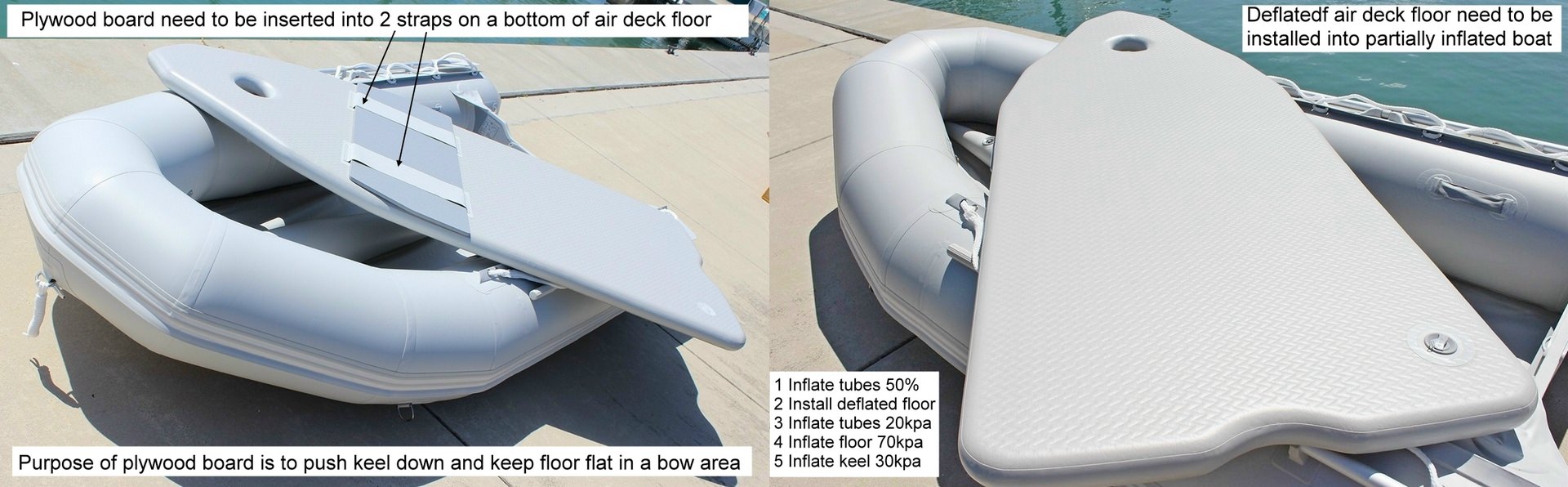
Steps for assembly inflatable boat with an air floor:
- Inflate all tubes to approximately 75% full.
- Insert boat seats in designated spots.
- Place deflated air floor inside the boat. The gray plywood board should be facing the keel. Make sure that the valve of the keel is accessible through the hole in the air floor. You will need it later to inflate the keel through this hole.
- Place both ends of plywood boards under the left and right sides of tubes.
- Stretch the air floor along the boats bottom, so it covers it from nose to transom. The rear end of the air floor should be touching the transom.
- Inflate the air floor until it's hard. You will know that the floor is fully inflated when the air pressure starts pushing the air pump handle up.
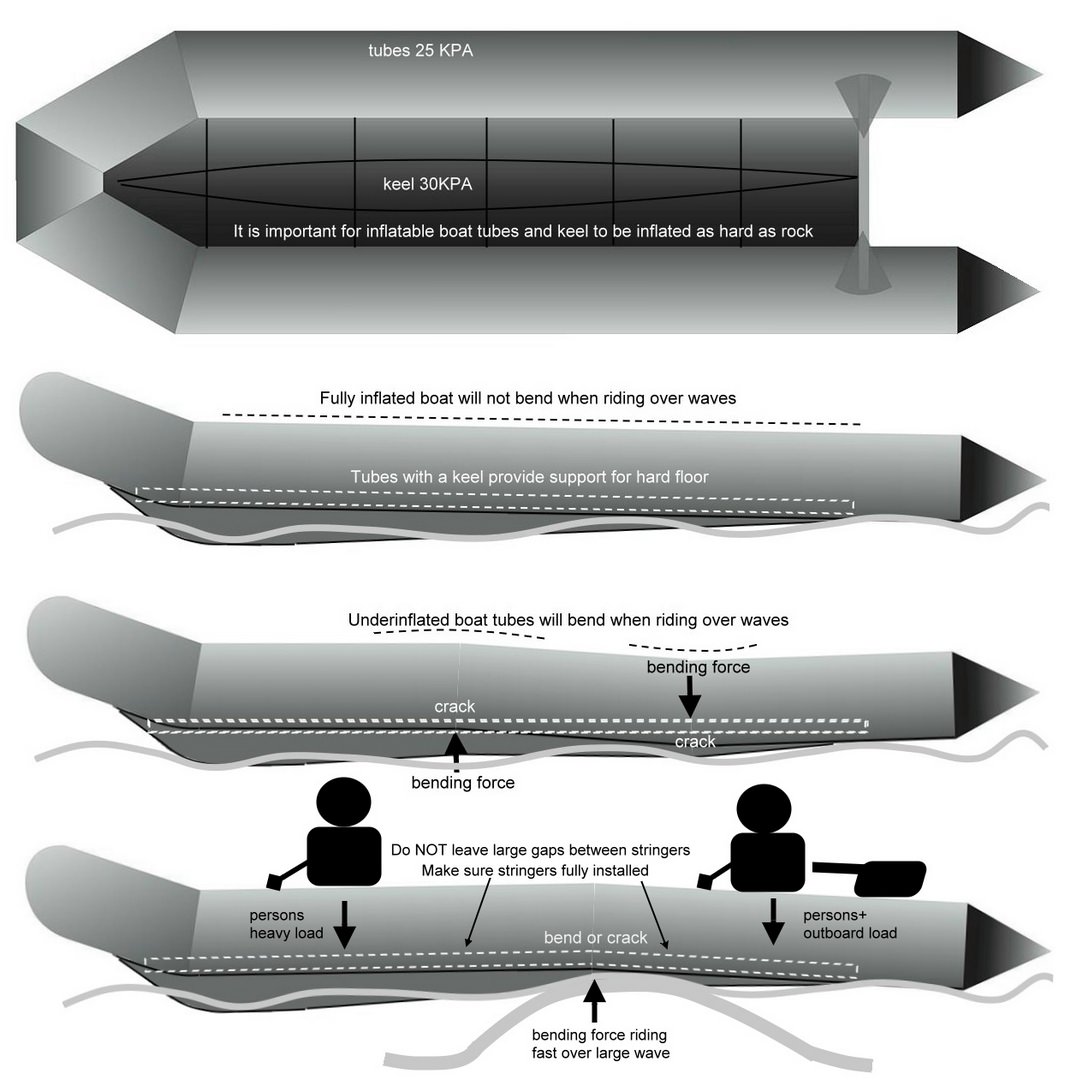
- Inflate all tubes 100% until hard to touch.
- Inflate the keel through the hole in air floor.
Steps for assembly inflatable boat with plywood floor. Click image to zoom in:
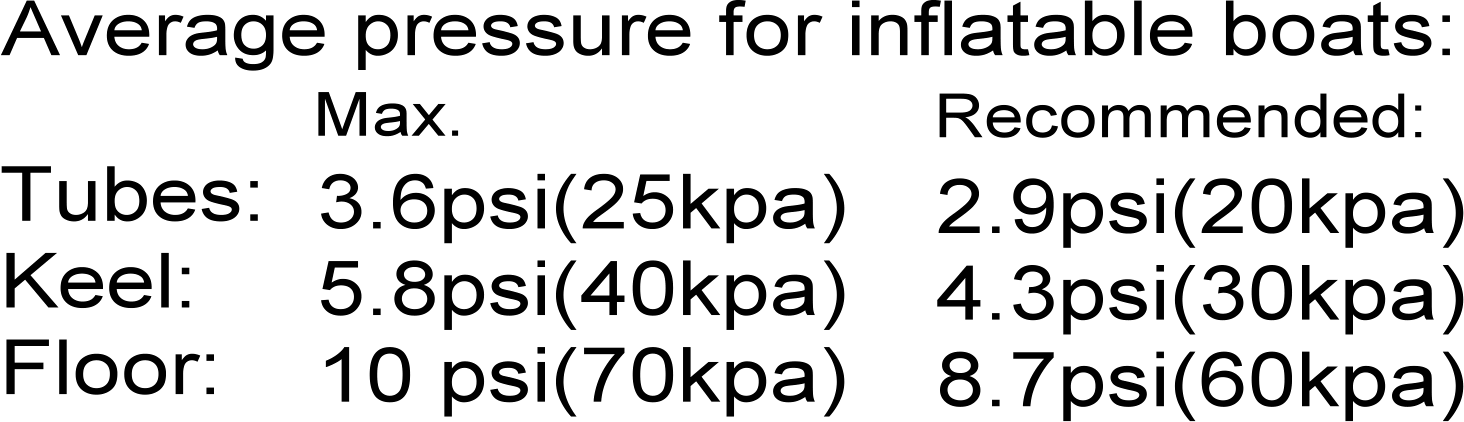
What is the working air pressure, and do I need
a pressure gauge?
It is not necessary to have an air pressure
gauge to inflate Saturn boats. The boat tubes are equipped with
Safety valves that will prevent over-inflation. In general,
when you feel that boat tubes/floor are hard to the touch, and
it becomes difficult to pump any more air in, that means
that the boat is ready.
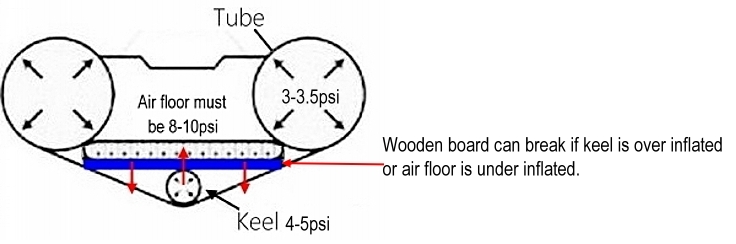
However, if you are using a high-pressure electric air pump, please use below guidelines to avoid boat over-inflation and consequential damage.

- 1 psi = 0.06895 bar
- 1 bar = 14.50326 psi
- 1 kpa = 0.145 psi
How
do I tie up my inflatable dinghy boat to the dock?
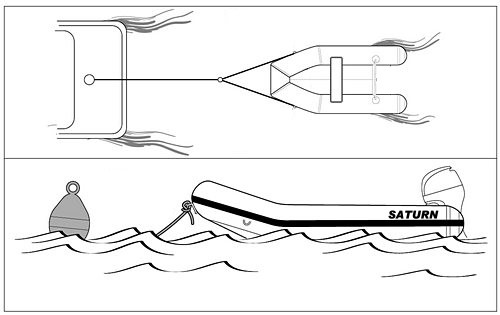
If you are planning
to keep your inflated dinghy in water or by the dock for extended
periods of time, here is a simple scheme that you may follow.
Gray PVC 1/2" electric pipes can be used as pole
supports. PVC pipes are available in local hardware stores and
Home Depot. They provide enough tension to keep the dingy from
rubbing against the dock. However keep in mind that prolonged
exposure to open water will cause extensive algae and barnacle
growth on the bottom part of the boat.
How to make inflatable boat seat bench to be softer on a bumpy rides?
Here is a web page with a FREE instructions
for how to make Deluxe Soft Cushion that will go over your
boat plywood or aluminum bench. This is complimentary
instructions for DIY project provided as-is as a gift to our
customers. We will not be able to provide any other information
besides already provided on that page.
How to make swim ladder to get into
inflatable boat from the water?
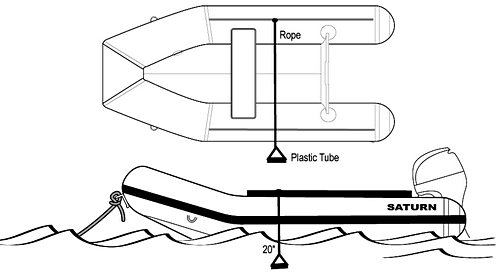
You will need 8-9 inch long pieces of 2" diameter white plumbing PVC pipe and a piece of thick rope. Drill holes at the end of each pipe and run the rope from one hole to another.
Make 2 knots where the rope exits the holes in the pipe, to make sure that the pipe will stay in place and will not slide when boarding the boat.
Make knots along the rope to assist with pulling yourself out of the water. Attach rope to the grab line, or any other place that can support heavy weight and throw the other end of the rope across the boat into the water, so that it is 20" below water line.
When boarding, insert one foot inside the loop with the pipe and grab the rope with both hands. Pull your body inside the boat, by using knots on the rope to help you up.
|
|
|

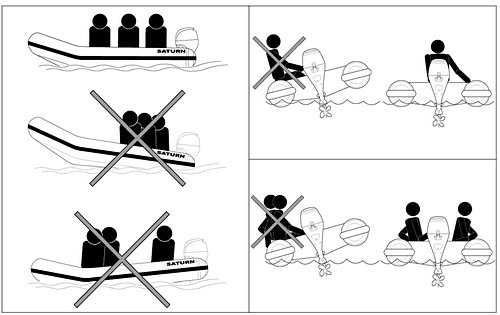
How to properly load inflatable boat?
Please see below for proper loading of the inflatable boat:

Where do I get a Bill of Sale and
Manufacturer Certificate Of Origin in order to
register my boat?
If the Bill Of
Sale is missing from the shipping pouch or you need replacement
documents, you can download the necessary paperwork by clicking on
the Downloads
link.
The keel tube under the floor is skewed to one side. How to
fix it?
1. Deflate boat tubes.
2. Deflate and remove air floor.
3. Inflate keel and then deflate it while spreading it out evenly on both sides.
4. Insert air floor back and inflate boat tubes 100%.
5. Inflate air floor, then inflate keel.
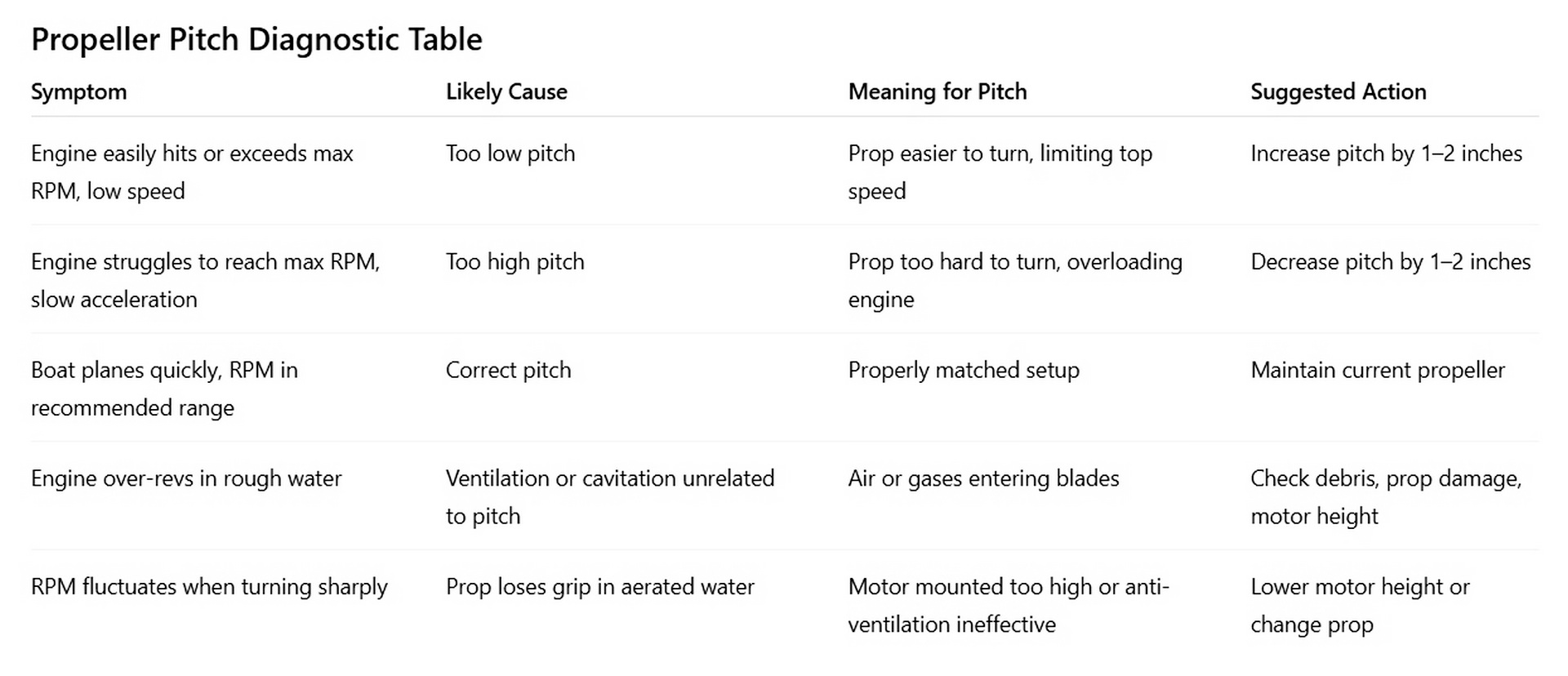
How to fix cavitation in inflatable boat or dinghy?
3rd, and often overlooked reason for cavitation is seaweed and/or debris in a water stuck to outboard skegs or prop. Even a little bit of seaweed or piece of plastic bag stuck in small outboard can cause it to cavitate. Easiest fix for that is to put motor in a neutral, and clean debris around prop. Make sure prop is not rotating.
The most recent response from a customer who fixed cavitation by properly inflating his SD365 boat was: "Thanks, I did what you said and went out in the ocean today and my boat ran great, really moves with this Honda 20hp outboard."
More Info about Cavitation due to the outboard propeller:
Ventilation occurs when surface air or exhaust gases are drawn into the propeller blades. The load on the propeller is reduced by the mixing of air or exhaust into the water steam causing over revving.
Anti-ventilation Plate: A large plate cast into gear case housing directly above propeller. Helps reduce surface air from being pulled into the blades.
Cavitation: The aeration (bubbling) and boiling effect of water caused by creation of a low pressure area. Generally caused by a solid shape (propeller blade) passing through the water, in such a position and speed, that a low pressure area is formed due to the inability to move through the water in nonresistant manner. An example is, a propeller blade that has a rough edge would not cut efficiently through the water, thus creating a low pressure area. If the pressure drops below the vapor pressure, a cavitation bubble will form in that region. These bubbles will collapse when they reach the higher pressure region of the blade. This causes a rapid change in pressure and can result in physical erosion. You may notice burns (erosion) at some area on the face of the blade.
How
can you avoid slipping in the boat seat while the boat is in
motion?
You
can apply a non-slip stair tread tape which is manufactured
by 3M. It is very durable and is water resistant as well.
It is available in most hardware stores. It is made
to be used on stairs but also works well on boat
seats to keep you from slipping into turns when a boat is in
motion. It makes the seats non-slip!
What
to do if water slowly leaking into inflatable boat?
Most
likely place where water can enter inflatable boat is a
one-way drain valve. There are several reasons why water may
sip into the boat, and fixes are usually quick and easy.
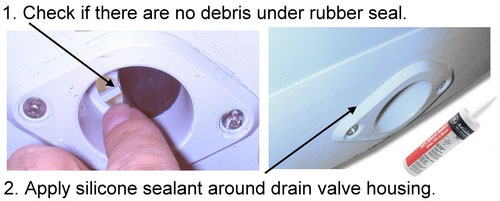
- Drain plug is not fully inserted. Please make sure there are no debris on a plug, and press on drain plug to make sure it is all way in.
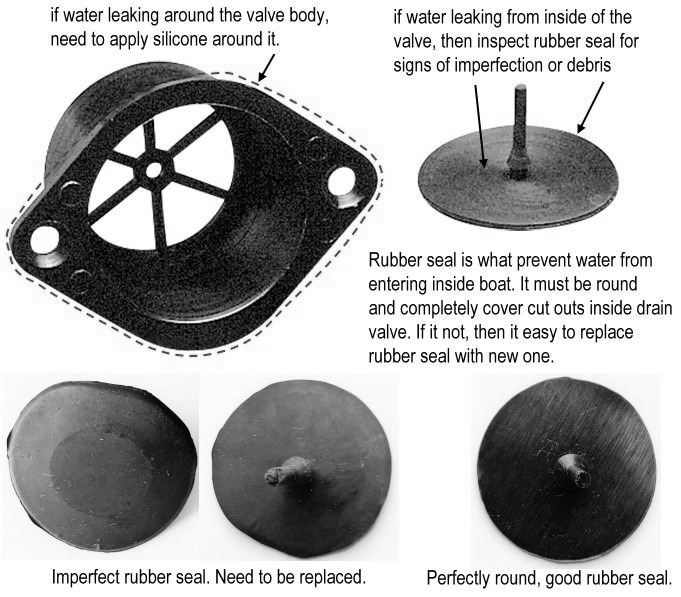
- One-way rubber seal that lock the valve is dirty, or there are debris under the seal. Pull rubber seal with your finger and inspect for debris stack between seal and plastic housing. Wipe rubber seal with an acetone.
- Drain plug assembly got loose or not enough sealant under the drain valve. Tighten screws on a drain plug while avoiding cracking plastic part. Apply door/window clear silicone sealant around drain valve assembly. Replacement drain plug assemblies are also available per request.

How to minimize pressure
on seat bench by heavy person?
Put a regular cooler between the seat and air
or plywood floor to create extra support for the plywood seat.
The cooler has to fit under the seat. There are IGLOO or
Coleman coolers
available in department stores that are just the right size.
Coolers can also serve as dry storage containers. When a boat is jumping on waves, coolers will prevent excessive pressure on the strips that hold the plywood seat attached to the tubes. For example, a Coleman 9 Qt. Excursion, Red cooler, dimensions 11.25" x 12.66" x 9.75", Vendor Part Number: 6209A703G, around $15.
Can inflatable boat be fixed if it get a really big cut?
One of our customers cut 4' opening in a boat
tubes when he run over sharp rock. Here is a quote from his
email:
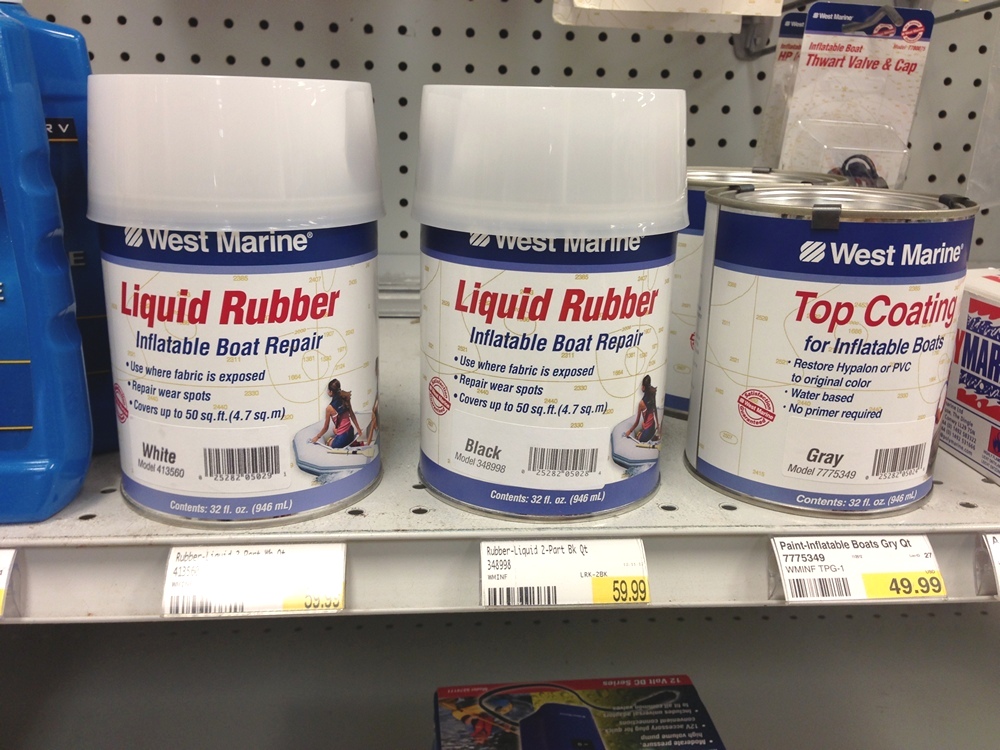
"Below is not a very good photo, but it may serve to remind you of the 4 foot gash I had on the port chamber of my 14-foot Saturn. Since this was taken, I have put on the big motor and been bopping all around the huge bay of Culebra, PR. She runs like new!!! I can hardly believe it.
Most boat people here never thought the gash could be fixed. What you see here is only the top part. As you get further under the chamber, the tear continues for another 2 feet toward the stern. I had a local guy here stitch first from the inside, then from the outside. He began layering the patches, using 5200 Sealant. It still leaked after that, but only thru small pinholes. It was then I I found at Inland Marine an expensive liquid adhesive that gets applied from INSIDE the chamber. Then the boat gets rocked back and forth to spread the glue evenly. I gave it 2 "coatings" on 2 separate days. Then I went all around the perimeter (edges) of the patch again with a fresh application of 5200. And voila, it sealed perfectly, not the slightest leak.
For 5 days now I've been using the boat, and there's no sign of leakage, nor of the patch peeling back. Am I a lucky son of a gun, or what!!! The Saturn has proven to be so resilient. It just wants to please me. I'm very grateful for your extra PVC fabric AND SUPPORT! One day I will visit you in FL to shake your hands. Meantime, the Saturn name has gotten a lot of positive attention here on Culebra! Very best wishes." Mark
How to set up
trailer for inflatable boat?
Regular Jet Ski trailer will work just fine for almost any
inflatable boat. You can find used Jet Ski trailers at Craigslist.com, or look
up in local classifieds. Harbor
Freight Tools offers very inexpensive foldable utility trailers that
can be converted into boat trailer. Please see bellow excellent
video of trailer setup submitted by one of our customers. Click on Play
button to start.
Please send us your questions and we will add them to this FAQ list.